


Local SEO keywords are simply the phrases people type into a search engine when they're looking for something nearby. Think "best coffee shop in Brooklyn" or "plumber near me."
Unlike broad, general keywords that cast a huge net, these hyper-local terms connect you directly with customers who are actively looking to buy something right now, right here. Getting this right is the crucial link between your online efforts and people walking through your door.
Why Local Keywords Are Your Most Valuable Asset
Imagine you own a high-end custom furniture store. Running a national TV ad is like general SEO—it's broad, expensive, and reaches millions of people from Seattle to Miami who will probably never visit your shop.
Now, picture placing a beautifully designed flyer on the doorstep of every home in an affluent local neighborhood. That's your local SEO keyword strategy. It's targeted, efficient, and speaks directly to someone who can become a customer today.
This targeted thinking isn't just a niche tactic; it mirrors a massive shift in how people search. In fact, a staggering 46% of all Google searches now have local intent. This means nearly half the time someone uses Google, they’re looking for a local solution.
The Speed of Local Search
The path from a local search to a sale is incredibly short. Why? Because users who include a location in their query have a much higher intent to purchase. They aren't just browsing; they're solving an immediate problem or fulfilling a direct need.
Before we get into the details, let's look at the difference between general and local keyword intent. It's a fundamental concept that shows why focusing on "near me" searches is so powerful for local businesses.
General SEO vs Local SEO Keyword Intent
| Attribute | General SEO Keywords | Local SEO Keywords |
|---|---|---|
| User Goal | Research, information gathering, comparison | Find a specific business, get directions, make a purchase now |
| Example Query | "how to fix a leaky faucet" | "emergency plumber in Austin" |
| Geographic Scope | National or global | City, neighborhood, or "near me" |
| Purchase Intent | Low to medium | High to immediate |
| Business Outcome | Brand awareness, website traffic | Phone calls, store visits, immediate sales |
As the table shows, local keywords are all about action. General keywords build awareness, but local keywords drive revenue.
Consider these powerful statistics that highlight the urgency behind local queries:
- Immediate Action: An incredible 76% of mobile users who conduct a local search will visit a physical business within 24 hours.
- Direct Conversions: Nearly a third of those searches, 28% to be exact, result in an immediate purchase.
- High Engagement: A full 88% of local searches generate either a phone call or a store visit within a single day.
The data paints a clear picture: when customers search locally, they are ready to act.
From Digital Click to Physical Footstep
The beauty of focusing on local SEO keywords is that they directly bridge the gap between your online marketing and your bottom line.
Someone searching for "emergency roof repair in Austin" isn't doing academic research—they have a leak and need an expert, now. By ranking for this term, you become their immediate solution.
For any company with a physical location or a defined service area, a strong local SEO plan isn't just an option; it's the foundation of sustainable growth. Our guide on local business SEO provides a deeper dive into building this foundational strategy.
How to Find Your Most Profitable Local Keywords
Finding your best local keywords isn't some dark art reserved for SEO wizards. It’s really about getting inside your customer's head. The whole point is to create a simple, repeatable process that goes beyond random guessing and hones in on the exact phrases people type when they’re ready to pull out their wallets.
We'll start with your core services and then layer on specific words that scream "I need this now, and I need it near me."
Think of your main offerings—like "custom home builder" or "luxury skincare"—as your seed keywords. These are the starting blocks, the foundation that describes what you do at the most basic level. From there, we’ll build a powerful keyword list by adding modifiers that filter the audience down to your ideal local customers.
This quick flow shows how a simple local search turns directly into a customer walking through your door (or clicking "buy"), which really drives home why this is so important.
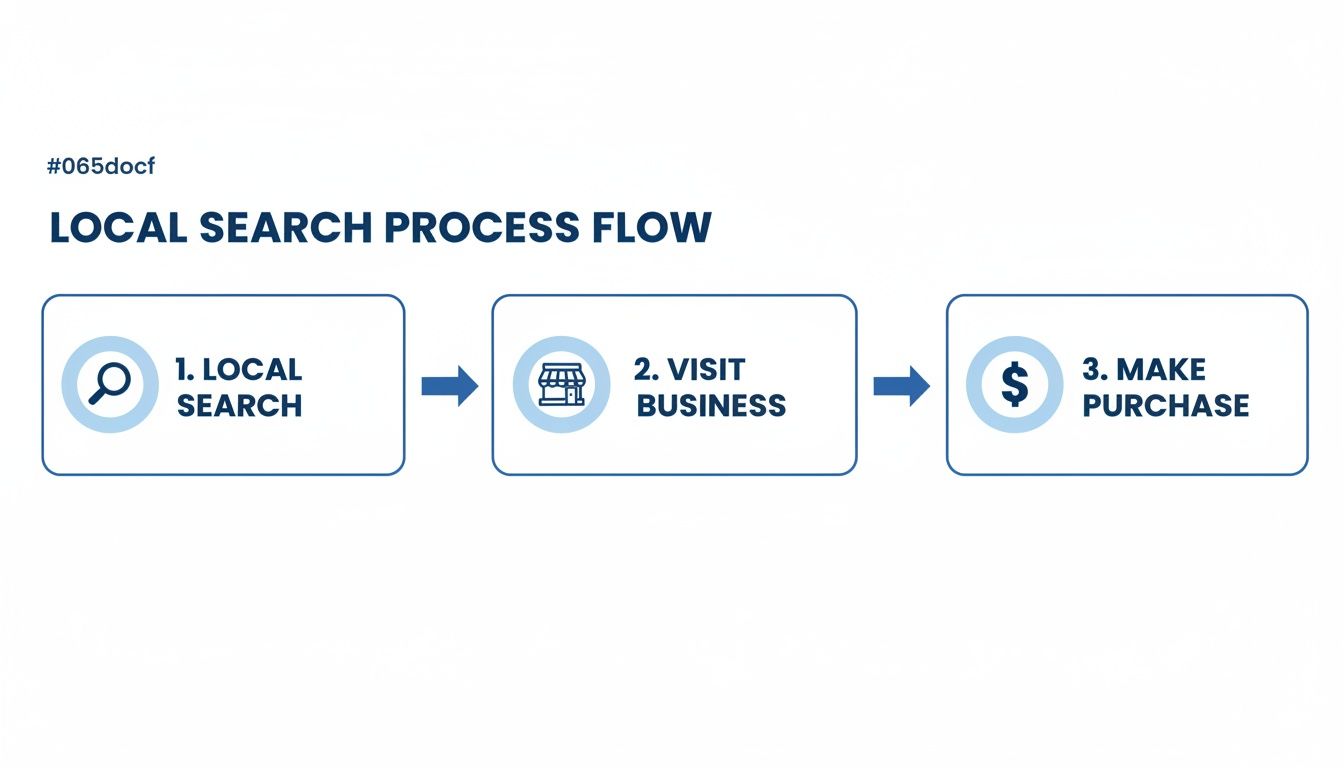
That path from search to sale is why nailing your local keywords is non-negotiable. It’s the very first step in connecting with nearby customers.
Brainstorming Your Core Keyword Buckets
To find your most profitable local keywords, it helps to understand the latest keyword research best practices to dominate transactional searches. I find the best way to start is by organizing your ideas into three main buckets. This approach makes sure you cover all the ways a local customer might look for you.
Seed Keywords (Your Services): This is the easy part. Just list out everything you sell or do. A high-end contractor, for example, would list things like "kitchen remodeling," "luxury bathroom renovation," and "custom home additions."
Location Modifiers: This is what puts the "local" in local SEO. Jot down every geographic term tied to your service area. Don't just stop at your city. Think about neighborhoods ("in Beverly Hills"), nearby landmarks ("near Central Park"), zip codes, and even unofficial area names that locals use ("in the Triangle").
Service Qualifiers: These are the words that add detail and clue you into what the searcher really wants. They can be descriptive ("emergency," "24-hour," "luxury," "eco-friendly") or action-oriented ("quote," "cost," "prices," "near me"). These are often the money-makers.
Key Insight: Your most profitable keywords almost always live at the intersection of these three buckets. A search like "emergency luxury plumber in downtown Austin" is a perfect storm—it combines a service, a qualifier, and a location, signaling someone has an urgent, specific need right now.
From Brainstorming to Building Your List
Once you have your three lists, it's time for the fun part: mixing and matching. This is how you create a master list of potential search terms. Let's say you're a DTC skincare brand with a physical shop in SoHo. You could combine your terms to generate phrases like:
- "anti-aging facial SoHo NYC" (Service + Location)
- "best luxury skincare shop near me" (Qualifier + Service + Location)
- "DTC beauty store in downtown Manhattan" (Qualifier + Service + Location)
This simple exercise can quickly give you dozens of long-tail keywords. These longer, more specific phrases might not have huge search volumes, but they convert like crazy because the person searching knows exactly what they want.
Using Tools to Validate and Expand
With a solid brainstormed list in hand, it’s time to bring in the tools. Platforms like Google Keyword Planner or Ahrefs will help you confirm your ideas are on the right track and uncover new ones you missed.
Here’s the critical step most businesses forget: filter your search results by your specific geographic area. Looking at the national search volume for "kitchen remodeling" is completely useless for a local contractor in Austin. You need to know how many people are searching for that term in your city.
This data helps you focus on keywords that have real, local demand. It's also a great idea to see what your competitors are ranking for; it can expose valuable terms you overlooked. For a full breakdown, you can learn how to do competitor analysis in SEO in our detailed guide. This whole process refines your list, leaving you with only the keywords that will drive meaningful, local traffic to your business.
Mapping Keywords to Your Website and Google Business Profile
Coming up with a great list of local keywords feels like gathering the perfect ingredients for an amazing meal. But just having the ingredients isn't enough—you need the recipe. Keyword mapping is that recipe. It’s the art of assigning each keyword to the exact right spot on your website and online profiles to get the most out of it.
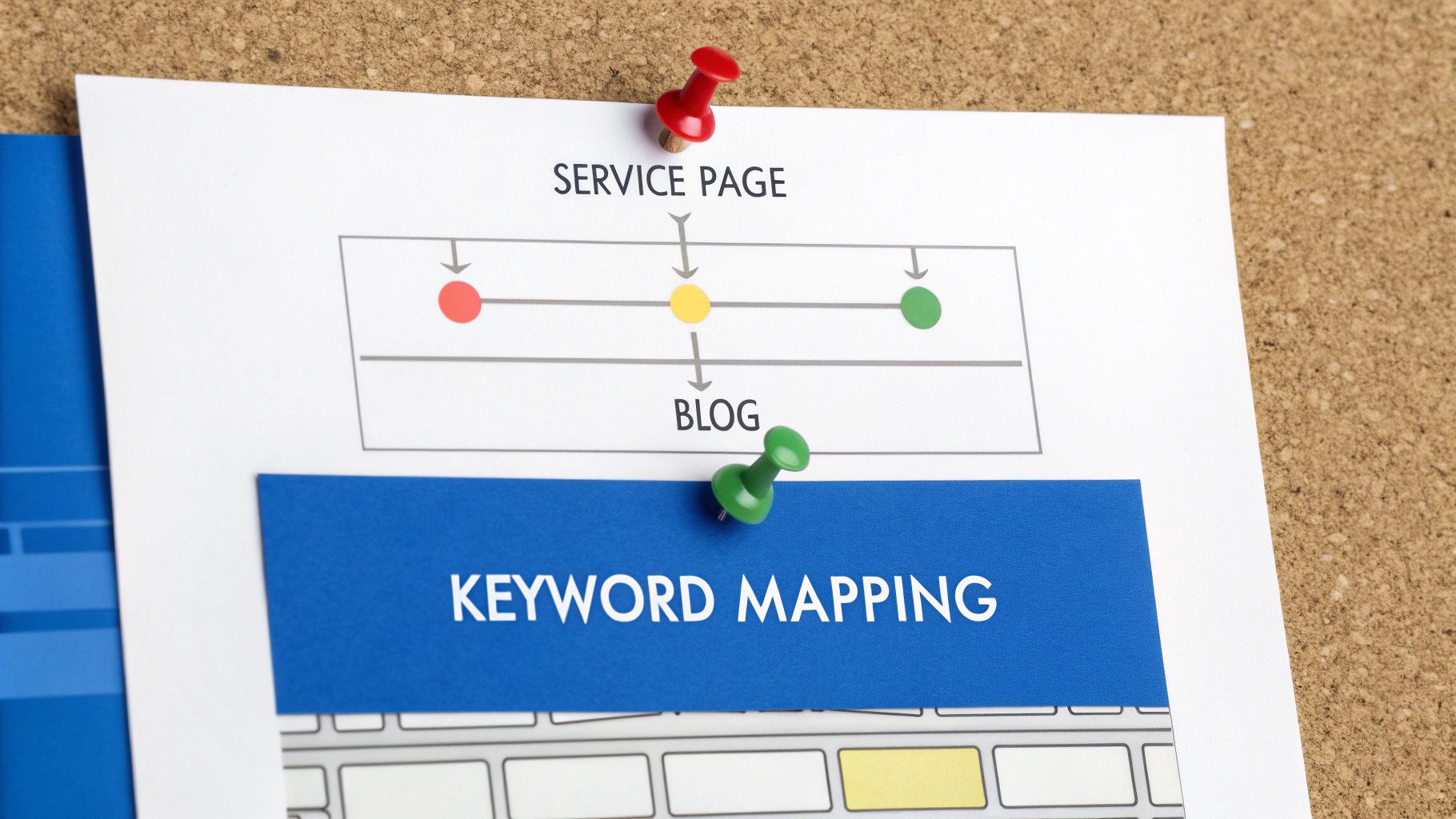
Without a clear map, you’ll just end up confusing both your visitors and the search engines. You might have several pages all fighting for the same keyword—a problem we call keyword cannibalization—which just weakens your authority and hurts your rankings. A smart mapping strategy gives every page a specific job, sending clear, consistent signals to Google.
This thoughtful approach makes your entire online presence work harder, making sure every page is perfectly tuned to pull in its ideal local audience.
Assigning Keywords to Website Pages
Think of your website like a well-organized department store. Every department—or page—has a specific purpose, and your job is to direct shoppers to the right one. Keyword mapping does the same thing, matching what a user is looking for with the most relevant page on your site.
Here’s a simple way to think about assigning your local keywords:
- Homepage: This is your digital storefront window. It should target your main branded keywords and the big-picture terms for your services. Think "luxury home builder Austin" or "KN Digital web design."
- Service/Product Pages: These are where the magic happens—where visitors turn into customers. Assign your high-intent, commercial keywords here. For a contractor, that means terms like "kitchen remodeling Austin TX" or "custom bathroom renovation quote."
- Blog Posts: Your blog is for answering questions and solving problems. This is where you target informational keywords, usually framed as questions. Good examples are "how much does a kitchen remodel cost in Texas?" or "best materials for luxury countertops."
By creating this clean hierarchy, you create a natural path for users from awareness to action, all while showing Google you're the expert.
Optimizing Your Google Business Profile
Your Google Business Profile (GBP) is probably the single most powerful tool you have for local SEO. A huge piece of the keyword mapping puzzle is figuring out how to rank higher on Google Maps by optimizing this profile. For many local customers, it’s the very first time they’ll encounter your brand.
Key Takeaway: Your Google Business Profile isn't just a business listing; it's a dynamic platform where you can strategically use keywords to dominate local search results. Think of it as a mini-website that Google prioritizes for local queries.
Weaving your local SEO keywords into the different parts of your GBP is how you boost your visibility in the local pack and on Google Maps.
- Business Description: Don't just list what you do; work in your main services and location keywords naturally. For instance, "As Austin's premier custom home builder, we specialize in luxury kitchen and bathroom renovations…"
- Services/Products: Add every single service you offer. Use your target keywords in their names and descriptions to explicitly tell Google what you're known for.
- GBP Posts: When you share updates, special offers, or new content, use relevant keywords in the text. This helps you show up for timely searches.
- Q&A Section: Get ahead of the game by adding and answering your own frequently asked questions. Use your keywords here, too. For example, post a question like, "Do you offer free quotes for kitchen remodeling in Austin?" and then write a genuinely helpful answer.
When you consistently enrich your profile with the right keywords, you send unmistakable signals to Google about who you are and what you do, connecting you directly with local customers who are ready to buy.
Turning Your Local SEO Keywords into Customers
Once you’ve got your keyword map, the real work begins. It’s time to move from planning to action, using that research to get found by local customers and drive them to your door. This involves a mix of on-page and off-page tactics that turn your keywords into real rankings and, more importantly, real business.
Think of it like this: on-page SEO is like arranging the inside of your store to be attractive and easy to navigate. Off-page SEO is like getting trusted local voices to recommend your shop. You absolutely need both to build a strong local presence.
A Practical On-Page SEO Checklist
On-page optimization is all about weaving your keywords into the very fabric of your website. This tells search engines exactly what each page is about and which local audience it’s for. It’s the foundational work that proves you belong in local search results.
Here’s a simple checklist to get your most important pages in shape:
- Title Tags: This is your page's headline in the search results. It needs to include your main local keyword and city. Something like, "Luxury Kitchen Remodeling in Austin, TX | Your Brand Name" is perfect.
- Header Tags (H1, H2, H3): Your H1 tag is the main title on the page itself—make sure your primary keyword is in there. Then, sprinkle variations and related keywords into your H2 and H3 subheadings to give the page structure and context.
- Body Content: Naturally work your main keywords into the first 100 words or so, and then throughout the page. The key is to write for people first. The keywords should feel like a natural part of helpful, clear information, not stuffed in.
- Google Maps Embed: This is a big one. On your contact page and any location-specific service pages, embed a Google Map showing your business address. It's a powerful and direct signal to Google that you're physically there.
Going Deeper with On-Page Signals
Beyond the basics, a couple of advanced moves can give you a serious edge. Creating dedicated landing pages for each city or even neighborhood you serve is a total game-changer. For example, a page titled "Custom Home Builder in West Lake Hills" will always beat a generic "Austin" page for that specific search.
Another crucial piece is local business schema. This is just a bit of code added to your site that clearly tells search engines your business name, address, phone number, and hours. It’s like handing Google your business card—it removes any and all guesswork.
Key Insight: Consistent NAP (Name, Address, Phone Number) information is the absolute bedrock of local off-page SEO. Even a tiny inconsistency, like using "St." on one directory and "Street" on another, can confuse search engines and weaken your authority.
Building Off-Page Authority with Citations
While on-page SEO is all about your own website, off-page SEO is about building your reputation across the rest of the internet. For local businesses, the most important factor here is citations—mentions of your business's NAP information on other websites.
Think of citations as votes of confidence from other reputable online sources. And remember, quality beats quantity every time. A single, accurate listing in your local Chamber of Commerce directory is worth more than a dozen listings on generic, spammy websites.
To get this right, you have to audit your existing citations. Use a tool or just manually search for your business to find any old, incorrect, or inconsistent NAP information. Cleaning this up is tedious but essential. It reinforces your digital footprint and builds a foundation of trust with search engines, cementing your place in the local market.
Adapting Your Strategy for AI and Voice Search
The way people search for local businesses isn't what it used to be. Old-school keyword stuffing is out, and a more natural, conversational style is in, thanks to tools like Siri, Alexa, and ChatGPT. This isn't a small tweak; it's a fundamental change in how your customers find you.
Think about it. Instead of typing "plumber in Austin," people are now asking their phones, "Who's the best emergency plumber near me to fix a leaking pipe?" Your local SEO strategy needs to catch up to this new reality.
To stay relevant, you have to start thinking less about keywords and more about answers. Your website's content needs to be the clearest, most helpful response an AI can find when someone asks a question related to your business.
Optimizing for Conversational Queries
The key is to focus on long-tail, conversational keywords. These are the full sentences and questions people use when they talk to a device or type into a chatbot. They're goldmines of information because they tell you exactly what a customer needs.
Here’s how you can start finding these valuable local SEO keywords:
- Think Like a Customer: What questions would you ask if you needed your own services? Brainstorm every potential problem, fear, or goal a customer might have.
- Use Question Starters: Frame your research around "Who, What, Where, When, Why, and How." Think of phrases like, "How much does a luxury kitchen remodel cost?" or "What are the best roofing materials for a windy climate?"
- Listen to Your Audience: Pay close attention to the exact words your customers use in phone calls, emails, and reviews. This is your best source for authentic, conversational keyword ideas.
This isn't some far-off trend—it’s happening now, and it's picking up speed fast. In January 2025, just 6% of consumers used ChatGPT to find local businesses. Fast forward one year to January 2026, and that number exploded to 45%. That's a massive 650% jump in only twelve months, making AI chatbots a huge channel for local discovery.
Structuring Content for AI and Voice
Once you've identified these conversational keywords, you need to format your content so AI and voice assistants can easily grab answers from it. A clean, organized structure is your best friend here.
Key Takeaway: AI-powered search engines are scanning for direct, concise answers to user questions. When you structure your content with clear headings and short, factual paragraphs, you're essentially handing them the perfect "answer snippet" on a silver platter.
A great way to do this is by adding FAQ sections to your service pages or writing blog posts that tackle one specific question at a time. Use the question itself as a subheading (H2 or H3), and put the answer right below it before going into more detail. This format is perfect for getting featured in Google's answer boxes and voice search results. As you dig deeper, you can learn more about how AI is changing SEO in our other articles.
By leaning into conversational questions and structuring your content to answer them directly, you're setting your business up to win in this new, AI-first world.
Measuring Success and Refining Your Local Keyword Strategy
Launching a local keyword strategy without a way to measure it is like driving in a new city without a map. You might be moving, but you have no idea if you're getting closer to your destination. A winning strategy isn't a "set it and forget it" task; it’s a living process of tracking, analyzing, and tweaking based on what the data tells you.
This constant feedback loop is what separates the businesses that just show up in local searches from those that truly own them. When you monitor the right metrics, you can stop guessing what works and start making smart, data-driven decisions that actually lead to local growth.
Key Performance Indicators for Local SEO
To see if you're on the right track, you need to focus on the numbers that connect directly to business outcomes—think phone calls, store visits, and sales. Forget about the vanity metrics and zero in on these Key Performance Indicators (KPIs).
Here are the most important ones to watch:
- Local Pack Rankings: Your spot in the "map pack" at the top of the search results is prime real estate. Moving from position four to position three can make a huge difference in your visibility and clicks.
- Google Business Profile Insights: This is your local SEO dashboard. Keep an eye on clicks-to-call, direction requests, and website clicks. These tell you exactly how people are engaging right from the search results page.
- Organic Traffic by Location: Dive into Google Analytics to see how much traffic is coming from your target cities or regions. A steady climb in local organic visitors is a great sign your strategy is paying off.
Tracking these KPIs gives you a clear picture of your performance, moving beyond simple rankings to measure what your potential customers are actually doing.
Leveraging Google's Free Tools for Analysis
You don’t need to spend a fortune on software to get started. Google gives you powerful, free tools that provide all the data you need to fine-tune your approach to local seo keywords.
Google Search Console (GSC) is your best friend for figuring out how your keywords are doing. The "Performance" report shows you the exact local searches driving clicks and impressions to your website. A great place to start is looking for queries with high impressions but low clicks—optimizing the page title or meta description for these could be a quick win.
Google Analytics (GA4) helps you understand what happens after someone clicks. You can segment your audience by location to see if visitors from your key service areas are converting. Are people from Austin spending more time on your site than visitors from Dallas? This kind of data helps you focus your efforts where they'll have the biggest impact.
Key Takeaway: Think of it this way: Google Search Console tells you how people find you, and Google Analytics tells you what they do once they arrive. Using them together gives you the full story of your local customer's journey, from their initial search all the way to a sale.
A Simple Framework for Testing and Refining
The only way to get better is to keep testing. Don't be afraid to experiment with your keyword strategy and let the data be your guide.
Here’s a straightforward A/B testing framework to follow:
- Form a Hypothesis: Start with a clear idea. For instance, "Adding the neighborhood 'West Lake Hills' to our service page title will increase clicks from that area."
- Make One Change: Update the title tag on that specific service page. It's important to only change one thing at a time so you know exactly what caused the result.
- Measure the Impact: Give it a few weeks, then hop into GSC to see if impressions and clicks for searches including "West Lake Hills" have gone up.
- Analyze and Repeat: If the change worked, awesome! Apply that learning to other relevant pages. If not, no problem—change it back and test a new idea.
This cycle of testing, measuring, and refining turns your local SEO from a one-off task into a powerful, self-improving engine for growth.
A Few Common Questions About Local Keywords
As you start putting your local keyword strategy into action, you're bound to run into some practical questions. It happens to everyone. This section is here to tackle the most common ones I hear from clients, giving you clear, straightforward answers to keep you moving forward.
Think of this as the bridge between theory and a real-world plan that actually drives revenue. Let’s clear up a few things.
How Many Local Keywords Should I Actually Target Per Page?
It’s tempting to stuff a page with every keyword you can think of, but that’s an old-school approach that just doesn’t work anymore. In fact, it can hurt your rankings.
For the best results, stick to one primary keyword and maybe two or three very closely related secondary keywords for each page. This creates a super-focused page that perfectly matches what a specific user is looking for.
For instance, a page for a contractor in Austin could target "custom home builder Austin" as its main focus. Your secondary keywords might be something like "luxury home construction Austin" or "high-end home builders in Austin." This sends a crystal-clear signal to Google about what that page is about, without muddying the waters.
What’s the Real Difference Between "Near Me" and Geo-Specific Keywords?
This is a huge one. You need to optimize for both, but they require different tactics.
- "Near me" keywords (like restaurants near me) are all about proximity. Google uses the searcher's live location to pull results from Google Maps. You win here by having a top-notch, active, and well-managed Google Business Profile.
- Geo-specific keywords (like restaurants in SoHo NYC) are when someone explicitly names a location. You optimize for these on your website by creating location-specific pages and building up local citations that mention your address.
A great local strategy weaves both types of keywords together. You’re catching the spontaneous, "I need it now" crowd and the people who are planning ahead from a different location.
A key thing to remember is that while "near me" searches are often immediate, geo-specific searches can signal a user who is planning a future visit or purchase. That’s a different kind of customer, but just as valuable.
How Long Does It Really Take to See Results from Local SEO?
Local SEO is a marathon, not a sprint. While you might see some quick wins, it’s a long-term investment in your business’s visibility. Generally, you should expect to see some initial movement in your rankings and a bump in local traffic within 3 to 6 months.
Of course, the timeline depends on a few things, like how competitive your market is, your website’s current authority, and how consistently you’re working on it. Often, the very first signs of life will show up in your Google Business Profile insights—things like more map views or clicks-to-call—even before you see big jumps in your website's organic rankings.
Ready to build a digital flagship that turns local searchers into high-value customers? The team at KN Digital specializes in conversion-focused web design and local SEO that drives measurable growth. Find out how we can elevate your brand and increase your revenue.