
A solid conversion rate optimization strategy isn’t about flashy pop-ups or tricking people into clicking. It’s a methodical process of refining your digital experience to guide more visitors toward becoming clients. For luxury and service brands, this is a delicate balance. The goal is to create an elegant, frictionless journey that turns browsers into loyal customers, boosting revenue without ever cheapening your brand's prestige.
Building a CRO Strategy That Honors Your Brand

Before you touch a single button or rewrite a headline, a sophisticated CRO strategy starts with a strong foundation. This first phase is all about discovery and alignment. It ensures every test and tweak you make serves a clear business purpose and reinforces your premium identity.
The first thing to do is look past the vanity metrics. Sure, a rising conversion rate is nice, but for a high-end brand, it doesn't tell you the whole story. The real insights are in the key performance indicators (KPIs) that reflect profitability and customer loyalty.
Beyond the Basic Conversion Rate
When we work with premium brands, we push them to track metrics that measure true business impact. These KPIs tell a much richer story about the health of the business and the quality of the customer experience.
Here’s a look at the kind of sophisticated metrics that really matter for measuring the success of your CRO efforts.
Essential CRO Metrics for Premium Brands
| Metric | What It Measures | Why It Matters for Your Brand |
|---|---|---|
| Average Order Value (AOV) | The average amount spent each time a customer places an order. | A premium, trustworthy site experience often encourages larger purchases. This tells you if your optimizations are building confidence. |
| Customer Lifetime Value (CLV) | The total revenue a business can expect from a single customer account throughout their relationship. | A seamless journey builds loyalty. Are customers returning to buy again? CLV is a critical indicator of long-term brand health. |
| Revenue Per Visitor (RPV) | The average revenue generated for each individual visitor to your site (total revenue / total visitors). | This metric combines conversion rate and AOV, giving you a clear picture of how much each visitor is worth. It's often more telling than conversion rate alone. |
By focusing on these numbers, you get a much clearer picture of whether your optimization work is actually growing the business in a sustainable way.
Conducting a Digital Experience Audit
With the right KPIs defined, the next move is a full digital audit. This isn't just about spotting bugs. It's about finding the "leaks" in your sales funnel where potential clients lose momentum, confidence, or interest.
Start by mapping the customer journey, from the very first touchpoint to the final conversion. Ask tough questions at each stage. Where are people dropping off most often? Which pages have unusually high bounce rates? Is the path from a product page to checkout intuitive and reassuring?
A core part of this audit is analyzing your competitors—not just to copy their designs, but to scrutinize how they balance an elegant, on-brand aesthetic with clear usability.
A well-executed conversion rate optimization strategy for a luxury brand should feel invisible to the user. The experience becomes so intuitive and reassuring that the path to purchase feels like a natural extension of their desire for your product, not a sales process they have to endure.
Setting Data-Informed Objectives
All this foundational work leads to setting clear, data-informed objectives. Instead of a vague goal like "increase conversions," you can set specific, measurable targets. For a closer look at this process, our guide on luxury brand website optimisation offers deeper context.
Your objectives might look something like this:
- Reduce cart abandonment by 15% in the next quarter by streamlining the checkout process and adding more prominent trust signals.
- Increase AOV by 10% within six months by testing personalized product recommendations on product and cart pages.
- Improve mobile conversion rate from 1.5% to 2.5% by optimizing page speed and simplifying navigation for smaller screens.
This structured approach turns CRO from a series of random guesses into a calculated business discipline. For a deeper dive into these fundamentals, check out this excellent guide on building a winning conversion optimization strategy.
By establishing this framework first, you ensure that every test you run and every change you implement not only drives growth but also elevates the customer journey—protecting the prestige you've worked so hard to build.
Decoding the Affluent Customer's Digital Journey

A solid CRO strategy for a premium brand has to go deeper than surface-level analytics. While your quantitative data tells you what is happening on your site, it's the qualitative insights that reveal the all-important why. This is the pivot point where you stop just tracking clicks and start genuinely understanding the nuanced behaviors and high expectations of the affluent consumer.
It all begins by seeing your digital storefront through their eyes. We need to develop a kind of data-driven empathy, and for that, qualitative feedback tools are non-negotiable. By watching how real users behave, you can pinpoint the subtle moments of friction or hesitation that standard analytics reports will almost always miss. This is how you create an online experience that feels just as personal and considered as your in-store service.
Seeing Your Site Through Your Customer's Eyes
Imagine looking over your customer’s shoulder as they navigate your website. That’s exactly what session recordings let you do. These tools capture anonymized user sessions, showing you precisely where they move their mouse, where they get stuck, and where they finally give up.
Heatmaps give you a complementary, aggregated view of user behavior laid out visually. You can immediately see which elements grab the most attention and which are being completely ignored.
- Click Maps: These show you which buttons, links, and even non-clickable elements people are trying to interact with. A ton of clicks on an unlinked image? That's a clear signal you have a UX improvement opportunity right there.
- Scroll Maps: This shows you how far down a page most people are actually scrolling. If your key value propositions are sitting below the average scroll depth, they’re effectively invisible to most of your audience.
These visual tools turn abstract numbers into actionable stories. You might discover a confusing product filter is causing widespread frustration or that a poorly placed call-to-action is being overlooked entirely. To really get inside the affluent customer's digital journey, you can get more great insights from this Practical Guide to Customer Journey Analytics.
Gathering Direct Feedback with Precision
Observing behavior is powerful, but sometimes the most direct route to understanding is to just ask. Thoughtfully designed customer surveys and feedback polls can deliver incredible insights, but you have to implement them carefully to avoid cheapening the luxury experience.
Forget about intrusive pop-ups. Instead, try more subtle methods:
- Post-Purchase Surveys: Ask recent buyers about their experience while it's still fresh in their minds. Focus on one or two crucial questions, like, "What was the one thing that almost stopped you from purchasing today?"
- Targeted Exit-Intent Polls: Trigger a simple, one-question poll when someone shows they're about to leave a key page, like the checkout. Asking, "Is there anything preventing you from completing your order?" can uncover critical friction points you never knew you had.
The goal here is to collect specific, actionable feedback that you can turn into hypotheses for A/B testing. For example, if several people mention being unsure about your return policy, that's a clear signal to make that information much easier to find.
A truly effective CRO strategy is built on a foundation of empathy. It's about translating user behavior—both observed and stated—into an experience that feels intuitive, reassuring, and effortlessly elegant.
This deep dive into user behavior becomes even more critical when you look at different devices. Device-specific conversion rates often reveal glaring priorities. It’s not uncommon to see dramatically different performance between desktop and mobile, with desktop conversion rates averaging around 4.8-5% while mobile lags far behind at 1.6-2.9%. For premium brands, where mobile can easily account for over half of all traffic, that gap represents a massive revenue opportunity that a smart CRO strategy simply must address.
How to Prioritize Your Optimization Efforts
Once you’ve gathered a ton of customer insights, the real challenge isn’t finding problems—it’s deciding which ones to fix first. A great CRO strategy isn't about throwing ideas at the wall to see what sticks. It's about a disciplined, structured approach to testing. Guesswork just wastes time and money; a solid plan makes sure every experiment pushes you toward real growth.
The first step is to turn your observations into testable ideas. I’m a big fan of a simple but powerful framework for this: the If-Then-Because model. This little trick forces you to connect a specific change to a clear outcome, all backed by the data you just collected.
For instance, say your heatmap shows visitors are completely ignoring your main call-to-action button. A weak hypothesis would be, "Let's change the button color." A much, much stronger one sounds like this:
If we change the primary CTA button color from grey to a high-contrast orange, then we expect to see a 15% increase in clicks, because our user heatmaps show the current button blends into the background and is being overlooked.
See the difference? This format gives you a clear, measurable, and justifiable reason for every single test you run.
From Ideas to a Strategic Roadmap
With a backlog of strong hypotheses ready to go, you need a system to rank them. The truth is, not all optimization opportunities are created equal. Some have massive potential but require a ton of development work, while others are quick wins with a smaller—but still valuable—impact.
One of the most effective prioritization models out there is the PIE framework. It’s a straightforward way to score each test idea based on three key factors:
- Potential: How much improvement can you realistically expect? This is often tied to how many users will actually see the change.
- Importance: How valuable is the traffic on this page? An improvement on a high-traffic product page is way more important than a tweak on a blog post no one reads.
- Ease: How hard will this be to implement? Think about the technical lift and the resources required. It's a reality check for your team's bandwidth.
By scoring each hypothesis on a simple 1-10 scale for each category, you can get a total score that lets you rank your priorities without endless debate.
Applying the PIE Framework in Practice
Let's walk through a quick example. Imagine a luxury skincare brand trying to decide between two tests. Here’s how the PIE model clears things up.
| Test Idea | Potential (1-10) | Importance (1-10) | Ease (1-10) | Total Score | Priority |
|---|---|---|---|---|---|
| A: Add Trust Badges to Checkout | 7 | 9 | 8 | 24 | High |
| B: Redesign Homepage Banner | 5 | 7 | 3 | 15 | Low |
In this scenario, adding trust badges (A) is the clear winner. It has a high potential to cut down on cart abandonment (Potential: 7), it impacts the most critical stage of the funnel (Importance: 9), and it’s a relatively easy job for a developer (Ease: 8).
On the other hand, a full redesign of the homepage banner (B) slides way down the list. It might have a moderate impact (Potential: 5) on an important page (Importance: 7), but it demands a ton of design and development time, making it a pain to implement (Ease: 3). This kind of data-driven thinking gets you out of subjective arguments and focuses your team's energy where it actually counts.
This systematic approach is what drives real results. While research shows the average A/B test can lift conversion rates by 49%, it’s a tactic that's still surprisingly underused. With only 44% of companies actively A/B testing, adopting a rigorous testing protocol gives you a serious competitive edge. Over time, consistent on-site testing can boost overall conversion rates by around 14%. If you want to dive deeper, these conversion rate optimization statistics really highlight the potential impact.
When you combine the "If-Then-Because" framework with a prioritization model like PIE, you’re not just testing—you’re building a strategic testing roadmap. This becomes a living document that guides your team through a continuous cycle of learning and improvement.
Enhancing the Luxury User Experience
This is where your strategy moves from a document to a real, elegant experience for your customers. For a luxury brand, user experience (UX) isn't just about making things work; it's a direct reflection of your prestige and meticulous attention to detail. Every click, scroll, and interaction has to feel intentional and seamless, turning the path to purchase into an enjoyable journey, not just a transaction.
I’ve seen too many brands fall into a common trap: sacrificing usability for a highly stylized, artistic design. A visually stunning website that’s slow or confusing will leak conversions, no matter how beautiful it is. The real goal is to blend that sophisticated aesthetic with intuitive function, making the entire experience feel both exclusive and effortless.
Crafting an Intuitive Navigation Flow
Customers looking for high-end products are often in a discovery mindset. They want to explore collections, learn about the craftsmanship, and feel a sense of confidence in their decision. Your site’s navigation needs to support this exploration without causing an ounce of frustration.
- Logical Grouping: Organize your products into clear, intuitive categories that match how your customers think. A luxury watch brand, for example, might categorize by collection, material (like gold or steel), or even by complication (chronograph, tourbillon).
- Visual Search: For aesthetic-driven products like fashion or jewelry, high-quality visual navigation can be a game-changer. A well-designed "Shop the Look" feature, for instance, lets users easily find the exact products featured in your editorial images.
- Minimalist Menus: Try to avoid overwhelming visitors with dozens of menu options at once. A clean, streamlined navigation structure reduces cognitive load and helps people focus on what really matters.
This flow chart gives you a simple but effective way to prioritize which UX enhancements to tackle first, based on their potential, importance, and how easy they are to implement.
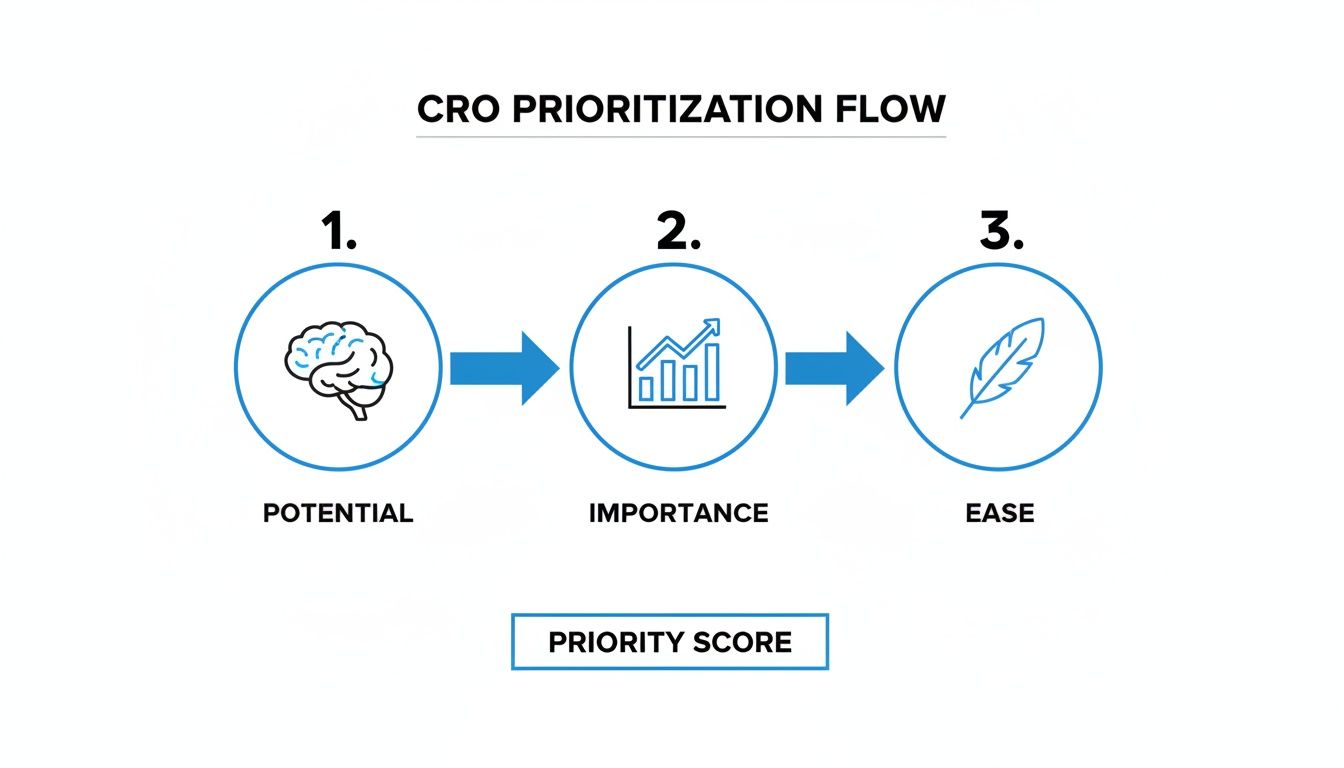
By balancing these three factors, you can build a data-driven roadmap that focuses your team's energy on the highest-impact improvements.
Designing Product Pages That Tell a Story
A luxury product page should do more than just list specs and a price. It needs to tell a story, evoke desire, and build unwavering confidence in the product’s value. Think of it as your digital showroom.
Your product imagery must be impeccable. Use high-resolution photos from every angle, lifestyle shots showing the product in context, and even detailed macro shots that highlight the fine craftsmanship. Video is also incredibly powerful here for demonstrating a product’s movement, texture, and scale.
Your product description is a golden opportunity to reinforce brand heritage and value. Don't just describe the item; narrate its story. Use evocative language to detail the materials, the inspiration, and the meticulous process behind its creation.
Streamlining the Checkout for Ultimate Trust
The checkout is the final, most critical step. For a luxury purchase, even the slightest hint of friction or insecurity can instantly kill a sale. The experience must feel secure, simple, and completely transparent.
Make guest checkout the default option. Forcing someone to create an account is a well-known conversion killer, especially for first-time buyers. Also, be upfront about all costs—including shipping and taxes—early in the process. Surprises at the final step are the number one reason people abandon their carts.
Finally, place trust signals prominently throughout the checkout. These include things like:
- Security Badges: Display SSL certificates and trusted payment logos (Visa, PayPal, etc.) to reassure users their information is safe.
- Clear Return Policy: Make your return and exchange policy easy to find and understand. A generous policy significantly reduces the perceived risk of a big purchase.
- Customer Support Access: Provide an obvious way to contact support, like a phone number or a live chat link, for any last-minute questions.
The Non-Negotiable Role of Performance
Ultimately, technical excellence is the foundation of a luxury user experience. Nothing erodes trust faster than a slow, buggy website.
Site speed and mobile responsiveness aren't just technical details; they are powerful signals of your brand's quality and professionalism. A mere one-second delay in page load time can reduce conversions by 7%—a massive loss for any business, let alone a luxury one.
Optimizing your site for speed means compressing images, minimizing code, and using a high-quality hosting provider. To dig deeper into this critical element, our deep dive explains why website performance is crucial for luxury e-commerce. By investing in a technically flawless platform, you ensure the user experience truly lives up to the promise of your brand.
Using Personalization to Create a Bespoke Journey
For luxury clients, personalization isn’t just a nice-to-have feature—it's an absolute expectation. A generic, one-size-fits-all website completely misses the mark, failing to deliver the curated and attentive experience your brand is built on. It's the digital equivalent of offering every customer the same off-the-rack suit.
An effective conversion strategy for a premium brand hinges on making every single visitor feel seen and valued. This means moving beyond static pages and embracing dynamic, adaptive experiences. When you transform your website into a digital flagship that provides a unique journey for every customer, you create an environment where conversion feels less like a transaction and more like a natural next step.
Tailoring Content with Dynamic Experiences
The most direct way to get started with personalization is through dynamic content. This just means showing different messages, offers, or imagery to different users based on data you already have about them. It’s a powerful way to make your site instantly more relevant.
For example, a visitor who clicks through from a marketing campaign about your new handbag collection should land on a page that prominently features those items, not your standard homepage.
Think about these common segmentation points for dynamic content:
- Geographic Location: A luxury outerwear brand can show heavy winter coats to visitors in colder climates while highlighting lighter jackets for those in warmer regions. Simple, but effective.
- Referral Source: Users coming from a partner publication, like a high-fashion magazine, can be greeted with a welcome message that acknowledges the partnership. This builds immediate rapport.
- Browsing History: If someone has repeatedly viewed a specific product category, like diamond engagement rings, your homepage banner can adapt to feature that collection on their next visit.
This level of relevance makes users feel understood, which goes a long way in reducing friction on their path to purchase. A tailored experience, as we demonstrated when we refined Prelux Concierge’s online presence with sleek UX, is key to engaging a high-end audience.
Driving Value with AI-Powered Recommendations
Beyond dynamic content, AI-powered product recommendations have become a cornerstone of modern luxury e-commerce. These systems analyze a user's behavior—what they’ve viewed, added to their cart, and previously purchased—to suggest other items they are likely to love.
When done well, this does more than just expose them to more of your catalog. It acts as a personal stylist, anticipating their needs and tastes. A customer viewing a silk blouse might be shown a perfectly matching skirt or complementary accessories, creating an organic opportunity to increase the average order value.
Personalization is the digital manifestation of exceptional customer service. It communicates that you not only know who your customer is but also what they desire, creating a bond that goes far beyond a single transaction.
Building High-Intent Audience Segments
To make any of this work, you have to segment your audience first. Grouping users based on shared characteristics is what allows you to create highly targeted campaigns that ensure your messaging and offers are always on point.
Start with these fundamental segments:
- New vs. Returning Visitors: New visitors might see a welcome offer or content that introduces your brand story. Returning visitors, on the other hand, could be shown new arrivals or items related to their past purchases.
- High-Value Customers: Your most loyal clients deserve an elevated experience. This could mean early access to new collections, exclusive content, or special offers that acknowledge their importance to your brand.
- Cart Abandoners: Users who left items in their cart can be targeted with a subtle reminder email or even a dynamic banner on their next visit, gently nudging them to complete their purchase.
This segmented approach has a massive impact. Personalization has emerged as a truly essential CRO strategy, with data showing that personalized calls-to-action convert 202% better than generic ones. Brands that segment their audience can more than double their conversion performance—a critical advantage in the competitive luxury market. To see more on this, you can explore the full findings on conversion statistics.
Common Questions About CRO for Premium Brands
Even with a solid playbook, jumping into conversion rate optimization can feel a bit daunting. For luxury and service-based brands, where brand perception is everything, it's completely normal to have questions about testing, timelines, and where to even begin.
Let's walk through some of the most common questions we hear. Think of this as the final briefing before you launch a disciplined, data-driven growth plan.
How Long Does It Take to See Results From a CRO Strategy?
This is usually the first thing leaders ask, and honestly, the answer has a few layers. While some A/B tests on high-impact pages can show statistically significant results in a few weeks, a real conversion rate optimization strategy is a long-term commitment, not a quick project.
You can often expect to see early lifts in user engagement—things like lower bounce rates or more people adding items to their cart—within the first 30 to 60 days. The more substantial, revenue-driving growth usually shows up after the 90-day mark, once winning tests are live and their effects start to build on each other.
The timeline really depends on two things:
- Website Traffic: The more visitors you get, the faster your A/B tests can collect enough data to be reliable.
- Implementation Speed: How quickly your team can actually roll out the winning changes is huge. A development bottleneck can really slow down your momentum.
The key is to see CRO as an ongoing process of improvement. The goal isn't a one-off win but building a culture of testing and learning that creates steady gains, month after month.
What Are the Most Common CRO Mistakes Luxury Brands Make?
In our experience, high-end brands tend to fall into a few specific traps that can really hold back their optimization efforts. The biggest mistake is prioritizing aesthetics over usability, no matter the cost. A visually stunning site that’s slow, confusing, or has no clear path to purchase will fail to convert, no matter how beautiful it is.
Another common slip-up is making major design and UX decisions based on gut feelings or what the team likes internally, instead of data. Without disciplined A/B testing, you're really just guessing what your customers want.
Finally, a surprising number of premium brands still don't give their mobile experience the attention it deserves, even though affluent customers do a ton of browsing and buying on their phones. A winning strategy has to find that perfect balance between brand prestige and data-driven functionality on every single device.
Can I Do CRO Myself or Should I Hire an Agency?
It’s definitely possible to handle some basic CRO work in-house. Simple A/B tests on things like headlines or button colors are a great way to get started and understand the process.
But a truly effective, large-scale conversion rate optimization strategy requires a pretty diverse set of skills. You need someone who understands data analysis, UX/UI design, user psychology, and development.
An experienced agency brings a proven process and access to advanced testing and analytics tools that are often tough and expensive to manage on your own. For luxury brands where the website is a primary growth engine, partnering with a conversion-focused agency usually delivers a much higher and faster return.
How Much Traffic Do I Need for Effective A/B Testing?
This is a critical technical question. As a general rule of thumb, you need at least 1,000-2,000 monthly conversions on a specific goal—not just visitors—to run A/B tests that reach statistical significance in a reasonable amount of time, usually two to four weeks.
If your traffic is below that, don’t worry. You can still run a powerful CRO strategy. Instead of leaning on statistical A/B testing, you just shift your focus to other high-impact activities. These include:
- Heuristic Analysis: An expert review of your site against established usability principles.
- Qualitative User Research: Getting deep insights from user testing, watching session recordings, and running surveys.
- Implementing UX Best Practices: Making common-sense improvements known to boost performance, even if you can't run a direct A/B test on them.
Ready to transform your website from a digital brochure into a powerful growth engine? The team at KN Digital specializes in building elegant, high-converting digital experiences for luxury brands. We combine data-driven strategy with impeccable design to drive measurable revenue growth.
Schedule your free consultation with KN Digital today
Article created using Outrank