


Doing an SEO competitor analysis is really about a systematic process of figuring out who you're up against in the search results. It involves looking at their keywords, content, backlinks, and even their site's technical health. All this information helps you spot gaps in their strategy, figure out what's working for them, and build your own plan to outrank them for the terms that actually make you money.
Why Competitor Analysis Is Your SEO Growth Engine

A lot of brands treat competitor analysis like a chore—something to check off a list instead of a real tool for growth. But here’s the thing: it’s so much more than just spying on the competition. Think of it as business intelligence that decodes why they rank, giving you a clear blueprint for your own success.
When you systematically dig into a competitor's digital presence, you get past flimsy metrics like raw traffic. Instead, you uncover the specific moves that drive qualified visitors and, more importantly, sales. This shift in mindset is everything. You're not just collecting keywords; you're reverse-engineering a path to getting more customers.
Beyond Keywords to Business Strategy
A good analysis gives you way more than a simple list of terms. It tells you:
- What kind of content actually connects with your shared audience—is it deep-dive guides, case studies, or maybe interactive tools?
- Where your competitors are dropping the ball, like having a slow site or completely ignoring valuable keyword groups.
- Their main channels for acquiring customers, which you can piece together from the types of backlinks they're getting and the platforms they focus on.
This level of insight can completely reshape your game plan. For instance, a luxury skincare brand might find out its biggest rivals aren't other skincare lines but high-authority beauty blogs. That discovery changes everything, shifting their focus from product pages to creating compelling editorial content.
A proper competitor analysis isn't about copying what others do. It's about understanding what works for them, identifying their weaknesses, and then creating something significantly better to capture their market share.
The Tangible Impact on Revenue
The connection between competitor analysis and revenue isn't just theory. In the cutthroat world of luxury eCommerce, where high-end skincare and jewelry brands are fighting for the top spots on Google, this process is a game-changer. I've seen it firsthand.
Take a B2B SaaS startup that analyzed its SERP competitors across 150 keywords. They found huge content gaps around "templates" and "workflows." They jumped on it, and their Share of Voice grew by an estimated 25% in just 90 days. We see similar results for premium direct-to-consumer brands, where top-ranking pages get the lion's share of traffic and often see click-through rates over 34%.
To get the most out of your SEO, knowing how to conduct a competitor analysis is the foundation for building a real strategy. It's the starting point for turning better visibility into more sales. You can learn more about how we connect SEO to revenue growth in our detailed guide: https://kndigital.co/seo-for-revenue-growth-how-increased-visibility-translates-to-higher-sales/
Identifying Your True Digital Competitors
The first mistake I see businesses make with competitor analysis is a big one: they assume the company across the street is their main digital rival. Your local business competitor might be stealing your walk-in customers, but it's often a high-authority blog or a massive online retailer that's actually gobbling up your online traffic.
You have to separate who you compete with for dollars from who you compete with for clicks.
Your real digital competitors are the websites that consistently pop up in search results for the high-intent keywords your ideal customers are using. We call these your SERP competitors, and they might not even sell the same thing you do. A luxury skincare brand, for instance, often finds itself battling beauty magazines and affiliate review sites far more than another skincare company.
Distinguishing Business Rivals From SERP Competitors
To get an accurate picture, you need to think like Google. Your job is to find the domains that own the digital shelf space for your most valuable search queries.
Start by brainstorming a core list of 5-10 "money" keywords. These are the terms a customer types right before they're ready to buy. For a local roofing company, that's something like "roof replacement near me," not a general query like "how to fix a roof leak."
With that list in hand, you can start digging:
- Go Incognito: Open a private browsing window and start searching for your core keywords. Jot down the top 5-7 domains that keep showing up.
- Use Your SEO Tools: Plug your domain into a tool like Ahrefs or Semrush and pull up the "Competing Domains" or "Organic Competitors" report. This will instantly show you who you’re fighting with for the same keywords.
This quick exercise is often an eye-opener. You'll probably see a mix of direct competitors, big-box retailers, content publishers, and maybe even a few Reddit threads. To really nail down your rivals, you have to learn how to find competitors of a website beyond just a few searches. The goal is to find who is genuinely capturing your audience's attention.
Building and Prioritizing Your Competitor List
Your initial search might give you a list of 20 or more domains. Trying to analyze all of them is a fast track to getting overwhelmed and doing nothing. The real work is in narrowing that list down to the top 3-5 most relevant and impactful competitors. These are the ones you'll put under the microscope.
You need a way to prioritize them. A simple scoring matrix can bring a ton of clarity to this process.
Competitor Prioritization Matrix
Use this matrix to score and rank potential competitors based on their relevance and SERP dominance, helping you focus your analysis on the rivals that matter most.
| Competitor Domain | Keyword Overlap (%) | SERP Visibility Score | Business Relevance (1-5) | Final Priority Score |
|---|---|---|---|---|
| competitorA.com | 65% | 8.2 | 5 (Direct Competitor) | High |
| blogB.com | 40% | 7.5 | 3 (Content Competitor) | Medium |
| competitorC.com | 72% | 9.1 | 5 (Direct Competitor) | High |
| bigboxretailer.com | 25% | 6.4 | 2 (Indirect Competitor) | Low |
This kind of scoring helps you focus your energy where it will make the biggest difference. You're looking for that sweet spot: high keyword overlap combined with high business relevance. For service-based businesses, this is especially critical. If you need help with this, our guide on local SEO for contractors shows just how specific this analysis can get.
Focus on the competitors who not only rank for your terms but also serve a similar user intent. A high-authority blog might rank for "best leather wallets," but if you sell luxury bespoke wallets, your most dangerous competitor is the other bespoke brand ranking on page one, even if their overall traffic is lower.
Once you have your prioritized list of 3-5 competitors, you have a clear focus. These are the brands whose strategies we’re going to systematically deconstruct in the next steps to find actionable opportunities for your own growth.
Uncovering Competitor Content and Keyword Gaps

Alright, you've got your list of competitors. Now the real fun begins. This is where we shift from just knowing who we're up against to figuring out how they're winning SERPs and stealing your traffic.
At its core, a solid competitor analysis is all about dissecting their content and keyword strategy to find cracks you can exploit. This isn't just about downloading a giant CSV of keywords. It's about reverse-engineering what makes their content tick so you can pinpoint the topics, formats, and angles that connect with your shared audience.
Our goal here is simple: find out where they're strong, where they're weak, and—most importantly—where they're not even showing up.
Performing a Keyword Gap Analysis
The most direct path to finding low-hanging fruit is a keyword gap analysis. Think of it as finding a customer base your rival is serving that you've completely ignored. The whole point is to identify keywords your competitors are ranking for, but you aren't.
Most of the big SEO platforms like Ahrefs or Semrush have a tool built specifically for this. You just plug in your domain and a few of your top competitors, and the tool cross-references everything to show you what you're missing out on.
The raw data will be overwhelming, though. Don't just export the list and call it a day. The real value is in filtering that noise to find the gold.
Here’s how I typically slice the data:
- Filter by Intent: I immediately zero in on keywords with commercial or transactional intent. Look for terms like "best," "review," "cost," or anything location-specific. These are your money-makers.
- Isolate Questions: Use filters to pull out anything phrased as a question ("how to," "what is," "why"). These are perfect for building out helpful, top-of-funnel content that brings new people into your world.
- Prioritize by Volume & Difficulty: The sweet spot is a keyword with decent search volume but a keyword difficulty score you can realistically compete for. These are your quick wins.
Beyond Keywords to Content Format Gaps
This is a powerful, and often completely overlooked, strategy. Instead of just looking at what your competitors are talking about, you need to analyze how they're delivering that information. Are they all just writing blog posts?
For example, let's say you're a high-end interior design firm. Your analysis shows that all your main competitors have blog posts titled "Luxury Kitchen Design Ideas." This is your chance to break the mold.
If everyone else has written a blog post, could you create an interactive kitchen design quiz, a high-production video tour of a recent project, or a downloadable PDF lookbook? Differentiating the format can capture an audience tired of the same old content.
Historical data backs this up. While Google now dominates over 90.83% of the global search market and the average top-ranking page often has more than 1,400 words, just writing more isn't the answer. The format and quality are what make you stand out, especially when 70% of searches are long-tail queries demanding very specific answers.
Analyzing Top-Performing Pages for Clues
Once you've spotted some keyword and format gaps, it's time to zoom in on your competitors' heavy hitters. Most SEO tools have a "Top Pages" report that shows which URLs are driving the most organic traffic for them. This is a goldmine.
For each of their top pages, I start asking questions:
- What's the topic and angle? Are they aiming at beginners or experts? Is the tone educational, or is it pushing for a sale?
- What's the content format? Is it a long-form guide, a simple listicle, a detailed case study, or a product comparison page?
- What on-page elements are they using? Do they have custom graphics, embedded videos, data tables, or an FAQ section? These details matter.
- What’s the user intent? Is this page meant to inform someone, help them compare options, or convince them to buy right now?
By breaking down their top 5-10 pages, you'll quickly see patterns emerge. This intelligence is invaluable because it's based on what's already proven to work in your niche. For example, you might see how one company successfully transformed its content hub by focusing on very specific user needs. This is how you build a content strategy based on evidence, not guesswork.
Analyzing Backlink Profiles and Authority Signals

Once you’ve dissected a competitor's content, it’s time to map out their authority. In Google’s world, authority is still heavily influenced by backlinks. Think of them as votes of confidence from other websites, signaling that your competitor's content is credible and worth paying attention to.
But not all votes are created equal. A single link from a major industry publication can carry more weight than a hundred links from low-quality directories. Your job isn't just to count backlinks; it's to reverse-engineer the quality and strategy behind their link profile. This process shows you exactly how they built their digital reputation, giving you a roadmap to follow—and improve upon.
Evaluating Backlink Quality Over Quantity
The first pass of any backlink analysis is about gauging the overall health of a competitor's profile. You're looking for patterns that tell a story. Are they actively earning high-quality mentions, or is their profile propped up by spammy, low-value links?
To get a clear picture, focus on these metrics:
- Referring Domains: How many unique websites are linking to them? A high number of referring domains is a much stronger signal than tons of links from just a few sites.
- Domain Rating (DR) or Authority Score (AS): Tools like Ahrefs or Semrush use these scores to estimate a site's authority. Check the average DR/AS of sites linking to your competitor to understand the quality of their network.
- Relevance: Are the linking sites topically related to your industry? A link from a niche blog in your space is far more valuable than a random one from an unrelated website.
By focusing on these signals, you start to see why a competitor ranks. For instance, a luxury home builder might find their top rival has dozens of links from high-end architecture blogs and local real estate magazines. That’s a specific, actionable insight. It tells them exactly where they need to build relationships to compete effectively.
Finding Their Best Links and Linkable Assets
With the big picture in view, it’s time to get granular. You need to identify the exact pages on their site that attract the most links and pinpoint their most powerful backlinks. This is where you find the strategies worth replicating.
Fire up your SEO tool and filter your competitor’s backlink profile to show their "best" links, usually sorted by the authority of the linking domain. As you scan this list, ask yourself a few questions:
- Are they getting featured on "best of" or "top 10" listicles?
- Do they contribute guest posts to influential industry blogs?
- Is their original research or data study being cited by others?
- Do they have strong local citations from business directories?
This process helps you uncover their linkable assets—the specific pieces of content that act as link magnets. Maybe they built a comprehensive guide, an interactive calculator, or a compelling case study that other sites just can't resist referencing. Recognizing these assets is the first step toward creating your own, even better, versions.
The goal isn't just to find links; it's to understand the strategy that earned them. Every high-quality backlink tells a story about a relationship, a piece of great content, or a PR win that you can learn from.
Uncovering Link Intersect Opportunities
One of the most efficient backlink analysis techniques is finding "link intersect" opportunities. This just means identifying websites that link to two or more of your top competitors but don't yet link to you.
These sites are prime targets. Why? Because they've already shown a clear interest in your industry and are willing to link to companies just like yours. They are, essentially, pre-qualified link-building prospects. Most major SEO platforms have a "Link Intersect" or "Link Gap" tool that automates this. Simply plug in your domain and the domains of your top 3-4 competitors.
The tool will spit out a list of websites linking to your rivals but not to you. From there, your job is to figure out why they linked to your competitors. Did they cite a statistic? Feature them in a product roundup? Understanding that context gives you the perfect angle for your own outreach.
Find Your Edge with Technical SEO and UX Smarts
Great content gets you in the door, but a rock-solid technical foundation and a smooth user experience (UX) are what seal the deal. If you're serious about creating a lasting competitive advantage, you have to look past keywords and backlinks. You need to dig into how your competitors' websites actually work for their users. This is where you find the subtle—but powerful—differentiators that both Google and your customers will reward.
A clunky, slow-loading website is a massive vulnerability. Let’s say your top rivals have pages that take an eternity to load. A faster, more intuitive site on your part isn’t just a minor tweak; it’s a competitive weapon. This whole exercise is about spotting those technical weaknesses and user friction points that you can turn into your strengths.
Assessing Core Technical Health
First things first, you need to run a high-level audit of your competitors' technical SEO. You don’t need to spend weeks on a forensic analysis, but you absolutely have to check the fundamentals that directly impact rankings and the user experience.
Start by zeroing in on these key areas:
- Site Speed and Core Web Vitals: Use Google's PageSpeed Insights to test their most important pages—homepage, top service pages, popular blog posts. A poor score, especially on mobile, is a golden opportunity for you to fly past them with a faster site.
- Mobile-Friendliness: Don't just check if their site is "responsive." Pull it up on your phone and actually try to use it. Is navigating a total nightmare? Are the forms impossible to fill out? A frustrating mobile experience is a huge, glaring weak point.
- Site Architecture and Navigation: How easy is it to find what you're looking for? A confusing, deep, or just plain illogical site structure frustrates users and makes it harder for search engines to crawl and index their content.
This initial check gives you a clear baseline. If all your main competitors are lagging here, investing in a high-performance website can give you a surprisingly quick lift in the SERPs.
A technically sound website is the foundation of modern SEO. It ensures that your brilliant content and hard-earned backlinks can actually be found, understood, and properly valued by search engines.
Decoding the On-Site User Journey
Beyond the raw performance numbers, you need to see how competitors guide people from a landing page to a conversion. This is where you put on your conversion rate optimization (CRO) hat and start hunting for UX intelligence.
Walk through their conversion funnels as if you were a potential customer. Sign up for their newsletter, add a product to the cart, or fill out their contact form. While you're doing this, pay close attention to their calls-to-action (CTAs).
- What language do they use? Is it compelling? Is it clear?
- Where are the CTAs placed? Are they buried at the bottom of the page or easy to find?
- What happens after you click? Is the next step logical and seamless, or does it feel disjointed?
By mapping out their user journey, you can spot the friction. For example, a competitor might have a fantastic blog post that gets tons of traffic but has no clear CTA to guide readers toward their services. That's a huge missed opportunity for them—and an easy win for you to implement on your own site. This process is all about finding these small but critical gaps in their on-site strategy.
This kind of deep dive is where professional tools become essential. Platforms like Semrush and Ahrefs are the heavy hitters in competitor analysis, recommended in 6 out of 10 expert guides for their comprehensive insights. For a luxury service brand like a home improvement contractor, these tools are invaluable. Semrush, used by over 10 million marketers, can uncover daily traffic data, overlooked keywords, and even Google Maps performance—which is critical, as 68% of online experiences begin with a search. Ahrefs’ Site Explorer, on the other hand, is fantastic for head-to-head backlink and keyword comparisons.
By plugging competitor domains into these tools, you can expose everything from their PPC strategies to their most glaring content gaps. To see what other tools the experts are using, you can discover more insights on Superhub.biz.
Turning Insights into an Actionable SEO Roadmap
All the data you’ve collected is useless if it just sits in a spreadsheet. This is where the real work begins—transforming those raw insights into a clear, prioritized plan of attack. You've done the analysis; now it's time for action.
An effective roadmap stops you from getting overwhelmed by a dozen different opportunities at once. Instead of trying to boil the ocean, you can focus your resources on the handful of things that will actually move the needle, driving real, measurable growth.
Creating a Prioritization Matrix
The best way I've found to bring clarity to chaos is a simple scoring framework. Start by listing out every single opportunity you've uncovered, from content gaps and link prospects to nagging technical fixes. Then, you'll score each one on just two criteria:
- Potential Impact (1-10): How much will this really affect traffic, leads, or sales? A high-impact item might be creating a new service page for a high-intent keyword your top competitor is dominating.
- Required Effort (1-10): How much time, money, and manpower will this take? A low-effort item could be as simple as updating an existing blog post with fresh data and a few new internal links.
Once you have those scores, the magic is in the math. Just divide the Impact score by the Effort score to get your final Priority Score. Suddenly, your path forward becomes crystal clear. The highest scores are your quick wins and top priorities.
This process flow diagram outlines the foundational technical SEO analysis steps, covering site speed, mobile-friendliness, and site structure.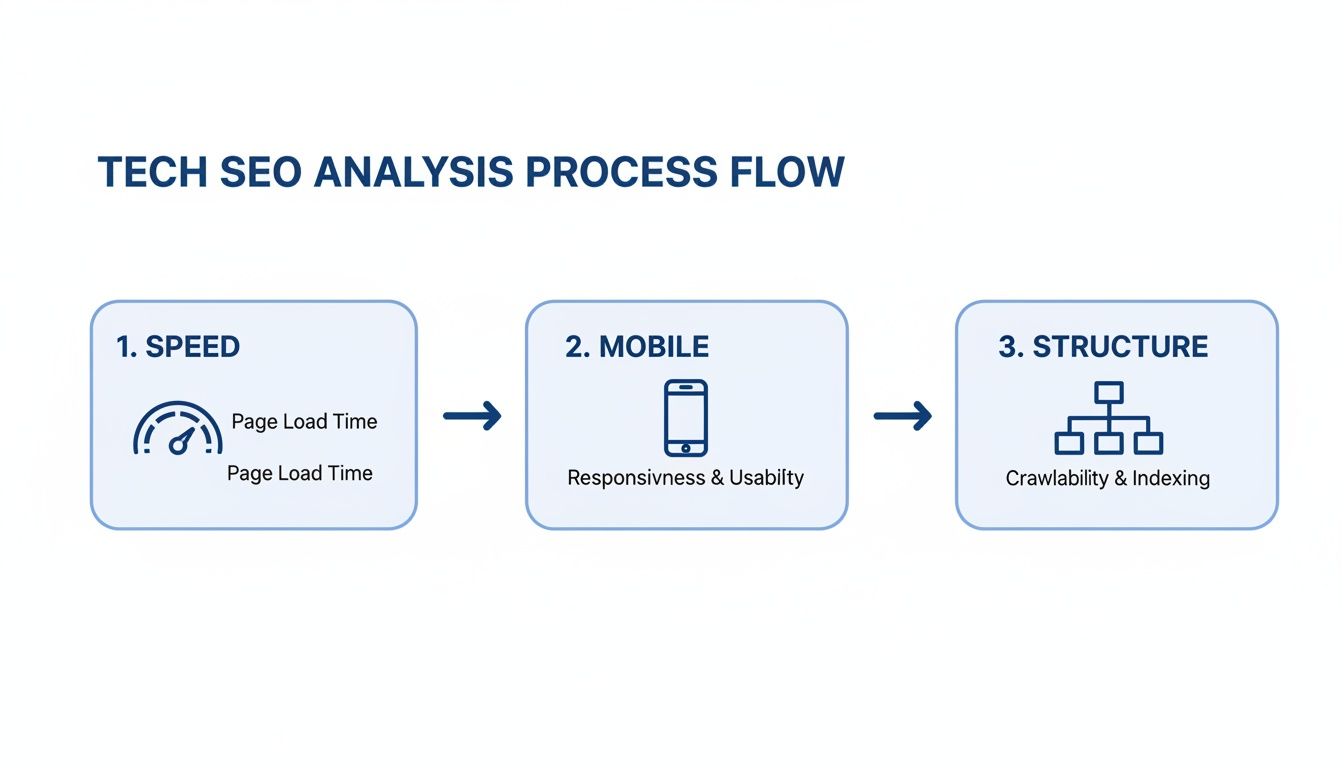
It's a great reminder that no matter how brilliant your content or backlink plan is, it all rests on a solid technical foundation.
SEO Opportunity Prioritization Matrix
A prioritization matrix is a simple but powerful tool. It forces you to objectively evaluate each SEO opportunity against the resources required, ensuring you're always working on the highest-value tasks first.
| Opportunity | Potential Impact (1-10) | Required Effort (1-10) | Priority Score (Impact/Effort) |
|---|---|---|---|
| Create new service page for "emergency plumbing" keyword gap | 9 | 5 | 1.80 |
| Fix 404 errors on key product pages | 8 | 2 | 4.00 |
| Write a comprehensive guide to compete with Competitor A's top blog post | 7 | 8 | 0.88 |
| Acquire 5 high-quality backlinks from industry blogs | 8 | 7 | 1.14 |
| Optimize meta descriptions for the top 10 underperforming pages | 5 | 2 | 2.50 |
By calculating the Priority Score, you can see that fixing the 404 errors and optimizing meta descriptions offer the biggest bang for your buck and should be tackled first.
Building Your 90-Day SEO Sprint
With your priorities straight, the next step is to map them out into a tangible 90-day plan. This timeline isn't just about scheduling; it's about creating accountability and building momentum.
Your competitor analysis shouldn't be a one-time report. It should be a living document that informs a dynamic, ongoing strategy for continuous improvement and market leadership.
Here’s what a sample 90-day roadmap might look like in practice:
- Month 1: Knock out the high-impact, low-effort tasks first. This could mean creating those three new service pages to plug keyword gaps and fixing the top five critical technical SEO errors you found.
- Month 2: Shift focus to higher-effort content creation. Develop and publish one major "linkable asset"—think an original study or an ultimate guide—inspired by a competitor's top-performing content. Then, begin outreach to 10 of the high-authority blogs you identified from their backlink profile.
- Month 3: It's time to scale and analyze. Promote your new content asset across all your channels. Start reviewing your keyword ranking improvements and use those early results to adjust the plan for the next 90 days.
Common Questions About SEO Competitor Analysis
When you start digging into competitor analysis, a few practical questions almost always come up. We hear these from clients all the time, so let's clear the air and give you the confidence to move forward.
How Often Should I Run a Competitor Analysis?
A full, deep-dive analysis is something you should tackle every quarter. This timing is the sweet spot—it’s frequent enough to catch major strategic shifts your competitors are making without getting lost in minor, day-to-day SERP fluctuations.
That said, you don’t want to be caught off guard. I always recommend a "light" check-in every month. Keep an eye on a small list of core keywords, watch for big new content pieces they launch, and track any new backlinks they pick up. This keeps you in the loop and prevents surprises.
What Are the Most Important Metrics to Track?
It’s easy to get lost in a sea of data. The key is to ignore the vanity metrics and focus on what actually signals a smart strategy and potential business impact. You're trying to decode their game plan, not just count their visitors.
Here's what I prioritize:
- Organic Keyword Overlap: This tells you exactly where you're fighting for the same turf. High overlap means they're a direct threat.
- Top Pages by Traffic: This is gold. It shows you their home-run content—the topics and formats that truly connect with your shared audience.
- New Referring Domains: This is a live feed of their link-building efforts. Are they getting press? Sponsoring events? It’s a direct look into their authority-building machine.
- Share of Voice (SoV): This metric gives you the bigger picture. It shows your visibility for a whole group of target keywords, not just one or two, painting a clear picture of who is dominating the conversation.
Can I Do This Without Expensive Tools?
You absolutely can, but be prepared for some manual legwork. The simplest starting point is to use an incognito browser window and search for your most important keywords. See who shows up consistently. This gives you a raw but foundational map of the competitive landscape.
While professional tools like Ahrefs or Semrush will give you a much deeper, faster, and more accurate analysis, don't let a lack of budget stop you. Manual methods can still uncover a surprising amount of strategic insight to get you started.
Free tools like Google Keyword Planner can give you some keyword ideas, but a paid subscription is one of those investments that quickly pays for itself in time saved and data quality.
Ready to turn these competitor insights into a website that actually converts? KN Digital specializes in creating high-performance digital experiences for luxury and service brands that drive measurable growth. Discover our conversion-focused web design and optimization services and see how we can elevate your brand.