
Getting more website conversions is simple, right? Just turn more visitors into customers. But it's really about strategic optimization—a methodical process of improving your site’s experience, performance, and messaging to guide people toward taking action, whether that's making a purchase or filling out an inquiry form. This isn't about slapping on aggressive sales tactics; it's about creating a digital journey that feels seamless and persuasive.
Your Playbook for Higher Website Conversions
Forget the generic advice you’ve read elsewhere. This playbook is built specifically for luxury and service brands, where every detail matters. Driving growth in a premium market demands a delicate touch, blending brand prestige with hard, data-driven performance. The average website conversion rate might hover around 2%, but for high-end brands, every single interaction carries more weight. A sophisticated approach isn't just nice to have—it's essential.
The real goal here is to boost conversions by creating an elevated digital experience, not by resorting to pushy pop-ups or countdown timers that cheapen your brand. This guide lays out a strategic roadmap built on three core pillars: User Experience, Technical Performance, and Brand Persuasion.
The Core Pillars of a High-Converting Luxury Website
To build a website that consistently turns discerning visitors into loyal customers, your strategy needs to cover all the bases. It’s not enough to have a beautiful design if the pages take forever to load. Likewise, a lightning-fast site won't do you any good if the messaging fails to connect. These pillars are designed to work together, creating a powerful and cohesive experience.
This table breaks down the foundational elements we'll be focusing on.
| Pillar | Focus Area | Key Metric |
|---|---|---|
| Elevated User Experience (UX) | Intuitive navigation, mobile-first design, frictionless processes. | Task Completion Rate |
| Flawless Technical Performance | Page speed, cross-device compatibility, bug-free functionality. | Core Web Vitals |
| Compelling Brand Persuasion | Authentic social proof, persuasive copywriting, clear value proposition. | Conversion Rate |
Think of these pillars as the legs of a stool—if one is weak, the whole thing becomes unstable. A successful CRO strategy addresses all three simultaneously.
The most significant gains in conversion rates don't come from a single magic bullet. They come from a relentless focus on removing friction and building trust at every touchpoint of the customer’s journey.
Throughout this playbook, we'll walk through how to diagnose hidden conversion blockers, optimize every interaction, and build a culture of continuous improvement. The strategies here are tailored for brands that need to maintain an air of exclusivity while still driving measurable results. If you want to go even deeper, our guide on luxury brand website optimisation offers more targeted insights.
Setting a Strong Foundation for Growth
Before we jump into specific tactics, it's crucial to get into the right mindset. Conversion Rate Optimization (CRO) isn't a one-and-done project; it’s an ongoing business discipline. It requires a real commitment to understanding your customer, gathering data, and testing your assumptions methodically.
We're going to move beyond surface-level analytics to uncover the why behind what your users are doing. This is your guide to achieving substantial growth without compromising your brand’s integrity—turning discerning visitors into loyal customers who feel understood and valued every step of the way.
Conducting a High-Impact Conversion Audit
Before you can fix what's broken, you have to see your website through your customers' eyes. This is where a high-impact conversion audit comes in. It's the only way to understand exactly where and why potential clients are dropping off.
This process goes way beyond just glancing at your Google Analytics dashboard. It's about uncovering the subtle friction points that sabotage the premium experience you're trying to create.
For a luxury or high-end service brand, this isn't about finding flaws for the sake of it. The goal is to build a prioritized roadmap of improvements, all ranked by how much impact they'll have and how easy they are to implement.
Blending The “What” With The “Why”
To get the full picture, you need to look at both quantitative and qualitative data. One tells you what is happening, and the other explains why.
-
Quantitative Data (The "What"): This is your hard data. It shows you the pages with high exit rates, where users abandon their cart, and which traffic sources convert best. It points you straight to the problem areas.
-
Qualitative Data (The "Why"): This is where the real magic happens, especially for premium brands. Tools like heatmaps and session recordings give you a window into the actual user experience. You can see where people are rage-clicking in frustration or watch a recording of someone leaving their cart right after seeing an unexpected shipping fee.
Combining these two is everything. For instance, your analytics might show a 40% drop-off on your custom inquiry form. But a session recording could reveal the "Budget" field is the culprit because the options feel too restrictive for a bespoke project. Without that "why," you'd just be guessing.
Mapping the User Journey with Precision
You have to meticulously analyze your entire conversion funnel to see where the momentum dies. This means mapping out the key steps a visitor takes from their first click to becoming a lead or customer.
Start by defining your primary conversion paths. For a high-end contractor, this might look like Homepage -> Portfolio -> Service Page -> Contact Form. For a DTC skincare brand, it's often Product Page -> Add to Cart -> Checkout -> Purchase.
Your website is your digital flagship. Every single interaction contributes to your brand's perception. A conversion audit is how you ensure every corner of that flagship is polished, functional, and inviting.
Once you've mapped the path, dive into the analytics for each stage. Look for major drop-offs. A high exit rate on a service page could mean your value proposition isn't clear enough. High cart abandonment often signals a clunky checkout process or a lack of trust-builders like security badges.
Prioritizing Your Optimization Roadmap
After this deep dive, you’ll probably have a long list of potential fixes. The trick is to prioritize them with a simple framework that scores each opportunity on two things: potential impact and ease of implementation.
| Potential Fix | Impact Score (1-5) | Ease Score (1-5) | Priority |
|---|---|---|---|
| Simplify Inquiry Form | 5 | 4 | High |
| Add Customer Testimonials | 3 | 5 | High |
| Improve Product Photography | 4 | 2 | Medium |
| Optimize Page Load Speed | 5 | 2 | Medium |
This method helps you focus on the "quick wins"—high-impact, low-effort changes—while you schedule the more complex projects. A structured approach makes sure your efforts are always aimed where they'll make the biggest difference.
This initial audit is the most critical part of any optimization strategy. To see how this process can be applied directly to your business, you can learn more about our complete luxury website revenue audit and how it uncovers hidden growth opportunities. By the end, you will have moved from guessing to knowing, armed with a data-backed plan to elevate your digital experience.
Optimizing for a Flawless User Experience and Speed
For a luxury brand, your website's performance is a direct reflection of your commitment to quality. A slow, clunky, or confusing digital experience instantly undermines brand perception and erodes the trust you’ve worked so hard to build. In this space, speed isn't just a technical detail—it's a core component of the user experience and a powerful driver of revenue.
This is all about ensuring your digital flagship performs as beautifully as it looks. For an audience that expects the best, a seamless and fast experience is non-negotiable. Slow load times aren't just an annoyance; they're a conversion killer, communicating that your brand doesn't value the visitor's time.
The data on this is stark and unforgiving. According to Google research, as page load time goes from just one to five seconds, the probability of a visitor bouncing increases by a staggering 90%. Even more compelling, reducing load time by a single second can boost conversions by 7%. Pushing that further to maintain speeds under two seconds can increase conversions by as much as 15%.
Pinpointing Performance Bottlenecks
Before you can fix what’s slow, you need to identify the culprits. A performance audit is your first move toward creating a faster, more responsive site that encourages visitors to stay and, ultimately, convert.
Your audit should zero in on a few key areas that are frequent offenders. These are often the low-hanging fruit that can provide the most significant speed improvements.
- Image and Video File Sizes: High-resolution imagery is essential for luxury brands, but I’ve seen unoptimized files become the number one cause of slow pages time and time again.
- Hosting Infrastructure: A shared, budget hosting plan simply can't provide the speed and reliability needed for a high-stakes eCommerce or service-based site. It's a common corner to cut, but a costly one.
- Bloated Code and Scripts: Over time, websites accumulate unnecessary code, plugins, and third-party scripts that run in the background, dragging down performance without you even realizing it.
A fast website feels effortless and premium. A slow website feels cheap and frustrating. Your site's speed is one of the most powerful—and immediate—signals of your brand's quality.
A thorough audit using tools like Google PageSpeed Insights will give you a clear, prioritized list of issues to tackle. This isn't just about chasing a perfect score; it's about systematically removing the friction that is costing you sales. You can learn more about how to boost conversions without compromising quality in our guide on website performance for luxury eCommerce.
Actionable Strategies for a Faster Site
Once you've identified the problems, it's time to implement solutions. These strategies will dramatically reduce your load times, improve user experience, and create a positive cycle that also benefits your SEO rankings.
1. Advanced Image Optimization
This goes beyond simple compression. Use modern image formats like WebP, which offers superior compression and quality compared to traditional JPEGs and PNGs. It's also critical to implement "lazy loading," a technique that defers loading off-screen images until the user actually scrolls down to them.
2. Choose the Right Hosting Environment
For any serious brand, a Virtual Private Server (VPS) or dedicated hosting is a must. These environments provide dedicated resources, ensuring your site's performance isn't dragged down by other websites on the same server. A Content Delivery Network (CDN) is another critical piece of the puzzle, as it stores copies of your site on servers around the world, delivering content faster to users no matter where they are.
3. Streamline Your Codebase
It's time for some digital spring cleaning. Conduct a plugin and script audit—deactivate and delete anything you aren't actively using. Additionally, use tools to "minify" your HTML, CSS, and JavaScript files. This process removes unnecessary characters from the code without changing its functionality, making the files smaller and faster to load.
For businesses looking to maximize their conversion potential, leveraging an AI chatbot for small businesses to boost support, sales, and growth can be a game-changer. These tools can improve user experience by providing instant answers and capturing leads without adding significant weight to your site.
Ultimately, optimizing your website's performance is a foundational step in any serious effort to increase conversions. It builds trust, delights users, and directly contributes to a healthier bottom line.
Building Trust with Persuasion and Social Proof
For any high-end brand, a beautiful design and a fast website are just table stakes. The real work—the part that turns a curious visitor into a committed client—is building unshakable trust. When people are considering a significant purchase, they don’t just need information; they need to feel confident they’re making the absolute right choice.
This is where persuasion and social proof come in. It’s not about manufacturing hype. It's about strategically showcasing the real-world success and satisfaction your clients have already experienced. A huge part of this is understanding the importance of online reputation, which acts as your digital handshake long before you ever speak to a potential customer.
Moving Beyond Generic Testimonials
Let's be honest: a single sentence like "Great service!" next to a first name does almost nothing for a discerning buyer. To be truly persuasive, your social proof needs to evolve from a flat, generic quote into a compelling story. The goal is to let prospective clients see a reflection of their own success in the stories of others.
Think about the difference. A generic testimonial is just a passive statement. A powerful case study, on the other hand, is an active narrative that walks a prospect through a real transformation.
- For a high-end contractor: Don't just post a review. Build a mini-case study. Show off stunning "before and after" photos of a kitchen remodel. More importantly, include a quote from the homeowner detailing how the new space has fundamentally changed how their family lives and connects.
- For a luxury DTC brand: Feature high-quality, user-generated content (UGC) right on your product pages. A professional photo of a necklace is one thing, but a real customer's photo of them wearing it at a black-tie event adds a layer of authenticity and aspiration you simply can't manufacture.
The most powerful social proof doesn't just tell a visitor you're good at what you do. It shows them the tangible, desirable outcome they can expect. It makes the decision to buy feel both logical and exciting.
By framing social proof as a story of transformation, you connect directly with a visitor’s aspirations. This approach validates their interest and reframes the purchase from a simple transaction into a wise investment.
Weaving Credibility Throughout the User Journey
Social proof is too valuable to be siloed away on a "Testimonials" page that no one ever clicks on. Its power multiplies when you integrate it seamlessly at key decision-making moments. The idea is to offer reassurance precisely when a visitor might start to feel a flicker of doubt.
Think about where a potential customer might hesitate and place a relevant piece of social proof right there.
This contextual placement answers objections before they can even fully form in a visitor's mind, providing that final nudge they need to move forward with confidence.
Social Proof Tactics for Luxury vs. Service Brands
The best approach to social proof isn't one-size-fits-all. What works for a bespoke jeweler might not be the right fit for a custom home builder. You need to tailor your strategy to what your specific audience values most.
Here’s a quick breakdown of how different tactics play out for product-focused luxury brands versus high-touch service providers.
| Tactic | Best for Luxury Brands (e.g., Jewelry) | Best for Service Brands (e.g., Contractors) |
|---|---|---|
| User-Generated Content (UGC) | Essential. Shows the product in real-life settings, creating desire and relatability. Think Instagram photos, unboxing videos. | Helpful, but less critical. Photos of a finished project are great, but the story behind it is often more important. |
| Expert Endorsements | Highly effective. Features in publications like Vogue or Forbes lend immediate credibility and prestige. | Effective. Endorsements from industry bodies or features in trade magazines can build trust in your expertise. |
| Detailed Case Studies | Good. Can work for high-value items by telling the story of the craftsmanship or a custom commission. | Absolutely critical. The best way to show the process, the transformation, and the client's satisfaction from start to finish. |
| Star Ratings & Reviews | Important. Customers expect to see ratings on product pages to validate their choice against others. | Very important. Aggregated reviews on sites like Houzz or Google are often the first stop for potential clients. |
| Celebrity/Influencer Mentions | Powerful. A well-aligned public figure can instantly elevate the brand's desirability. | Less effective. Trust is built on proven results for everyday clients, not celebrity endorsements. |
Ultimately, the goal is the same for both: use the authentic voices of happy customers to prove your value. The specific tools you use to get there will just look a little different.
The Power of Interactive Social Proof
Getting visitors to actively engage with your social proof can have a massive impact. One study found that when visitors interacted with user-generated content instead of just passively viewing it, their likelihood of converting doubled—that’s a 102% increase in conversions. For SaaS companies, the effect is even more dramatic, with conversions jumping by as much as 154%.
This means going beyond static text. Make your reviews searchable. Allow users to filter testimonials by project type. Create interactive galleries of customer photos.
When someone can easily find proof that’s directly relevant to their specific situation, it builds a powerful, personal connection. Your website stops being a simple brochure and becomes a dynamic, persuasive tool that proves your worth through the authentic voices of the people who matter most: your satisfied clients.
Implementing a Data-Driven Testing Roadmap
All the insights from your conversion audit are fantastic, but they're just theories until you prove them with real data. It's time to stop guessing what might work and start knowing what actually does. This is where a structured, data-driven testing roadmap comes in, turning your website into a perpetual optimization machine.
This process takes the mystery out of A/B testing. It's not some complex, intimidating concept—it's just a methodical way to increase conversions by pitting a potential improvement (Variation B) against your current design (Control A) to see which one performs better.
Building Your Hypothesis Backlog
Every solid test starts with a strong hypothesis. Your conversion audit should have already given you a prioritized list of issues and opportunities. Now, we'll turn those insights into testable ideas.
A proper hypothesis follows a simple, clear structure: "If I [change X], then [outcome Y] will happen, because [reason Z]."
Here's what that looks like in the real world:
- For an interior design firm: "If we change the primary call-to-action from 'View Our Portfolio' to 'Request a Consultation,' we will increase qualified leads because it speaks directly to high-intent visitors ready to start a project."
- For a luxury skincare brand: "If we add a 'Shop the Look' section with user-generated photos below the main product image, we'll see more add-to-cart clicks because it provides social proof and shows the product in a relatable context."
Each of these ideas gets logged in a central document—your testing backlog. Think of it as your menu of potential experiments, ready to be deployed one by one.
A testing roadmap isn't about throwing random ideas at the wall. It's a disciplined process of validating your most impactful assumptions, ensuring every change you make is a calculated step toward higher conversions.
This methodical approach shifts you away from subjective design choices and toward objective, revenue-driven decisions. The data from every single test—win or lose—is a valuable lesson that informs your very next move.
Prioritizing Your Tests for Maximum Impact
With a backlog full of great ideas, you need a system to decide what to test first. We can use the same framework from your audit: prioritize based on potential impact, your confidence in the hypothesis, and how easy it is to implement. You want to focus on tests that promise significant gains without needing a complete site overhaul.
Common high-impact areas to test usually include:
- Calls-to-Action (CTAs): Test the wording, color, placement, and size of your most important buttons.
- Headlines and Value Propositions: Does a benefit-driven headline actually outperform a feature-focused one? Let's find out.
- Page Layouts: Test some radical changes, like moving your social proof section above the fold.
- Forms: Can you boost completions by removing a few non-essential fields or trying a multi-step layout?
For example, on landing pages, a focused A/B testing strategy can increase conversions by as much as 30%. We've seen this play out in major ways. When FSAstore.com streamlined its lead funnel just by reducing form fields, they achieved a 53.8% increase in average sales revenue per visitor. You can explore more compelling CRO statistics on Shopify to see the full potential of a disciplined testing program.
Interpreting Results and Iterating
Once a test is done, the work isn't over. You have to analyze the results to understand why one version outperformed the other. Look beyond just the primary conversion goal. Did the winning variation also affect bounce rate or average time on page?
These insights are gold. A winning test gives you a direct improvement to implement. A losing test provides a crucial lesson about what your audience doesn't respond to, preventing you from making a costly mistake site-wide.
This process flow shows how you can build trust through stories, endorsements, and user-generated content—all powerful elements to test.
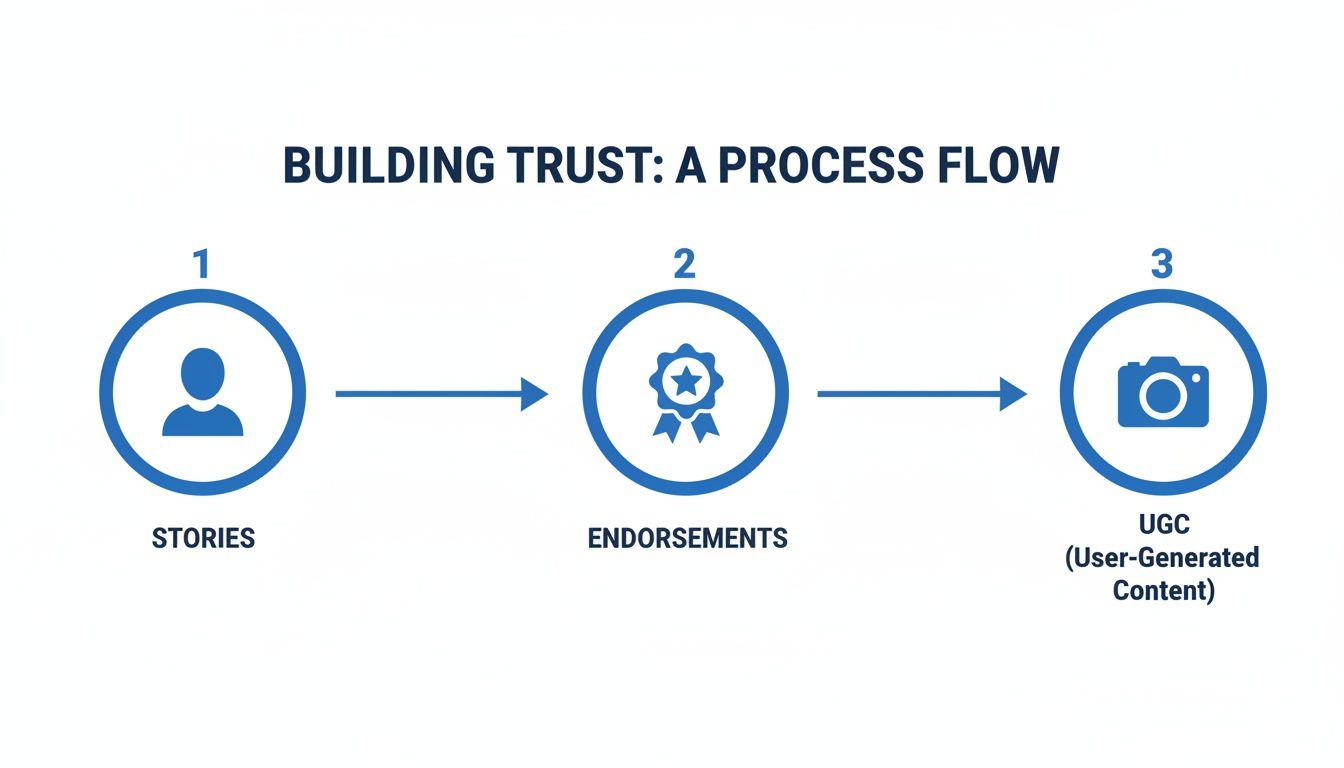
The key takeaway here is that each element builds on the last, creating a layered narrative of credibility that is ripe for A/B testing at every single stage.
Every result feeds back into your strategy, sharpening your understanding of your customer. This creates a powerful feedback loop where each test makes the next one smarter. It's an iterative cycle of hypothesizing, testing, learning, and improving that compounds over time, steadily pushing your conversion rates higher.
Common Questions About Website Conversions
Diving into conversion optimization always brings up some great questions, especially for luxury and service brands where every little detail can make a big difference. Here are the most common things we get asked by clients, with straightforward answers to help you get started.
How Long Does It Take to See Results from CRO?
This is usually the first question on everyone's mind, and the answer isn't a simple one. Some big-impact changes, like a major improvement in site speed, can show results in just a few weeks. But real, strategic CRO is a long-term commitment, not a quick fix.
Most brands start to see a significant, lasting lift in conversions—often in the 30% or more range—within the first 90 days of putting a solid plan in motion. The first phase is all about grabbing the "quick wins" we find during the audit. The growth that follows comes from a disciplined A/B testing plan, where small, smart improvements add up over time. Consistency is what really drives growth here.
Think of CRO less like a project with a finish line and more like a core business discipline. The real goal is to build a culture of continuous, data-driven improvement that becomes a permanent part of how you grow.
Can I Increase Conversions Without a Full Redesign?
Absolutely. In fact, it's usually the smarter and more effective way to go. A full website redesign is a huge undertaking—it's expensive, takes a lot of time, and is incredibly risky if it’s not built on a foundation of real user data. I've seen plenty of beautiful redesigns that actually hurt conversions because they were based on what someone thought would work, not what the data proved.
Good CRO is about making targeted, iterative changes to what you already have. It's like performing surgery, not a full transplant. You methodically find the specific friction points—a confusing checkout, a weak call-to-action, an unclear value proposition—and fix them one by one. This approach delivers big conversion gains at a fraction of the cost, time, and risk of a total overhaul.
What Are the Most Important CRO Metrics to Track?
While your overall conversion rate is the ultimate goal, staring at it alone can be misleading. To get the full story of your optimization efforts, you need to watch a few key performance indicators (KPIs) that paint a more detailed picture.
- Bounce Rate on Key Landing Pages: A high bounce rate on a critical page, like a service or product page, is a huge red flag. It tells you that your message or user experience is falling flat right when it matters most.
- Form or Cart Abandonment Rate: This number shows you exactly how many people start to convert but then drop off. It’s a direct measure of friction in the most important part of your funnel.
- Average Session Duration: While not a direct conversion metric, longer sessions often signal higher engagement and interest. And more engaged visitors are usually more likely to convert.
For luxury and service brands, it’s also critical to track micro-conversions. These are the smaller actions that signal strong intent, like watching a product video, viewing a portfolio, downloading a brochure, or signing up for a newsletter. Looking at all these metrics together gives you a much richer understanding of how people are actually using your site.
How Much Traffic Do I Need for A/B Testing?
The traffic you need for a reliable A/B test really depends on your current conversion rate and how much of an improvement you expect to see from the change. As a general rule of thumb, you’ll want at least 1,000 unique visitors and 100 conversions for each version you're testing. This usually gives you a trustworthy result within a reasonable timeframe, like two to four weeks.
If your site has lower traffic, don't sweat it—you can still optimize. Instead of getting bogged down in tiny A/B tests on things like button colors, you should focus on testing bigger, bolder changes that are more likely to create a dramatic impact. For sites with less traffic, focusing on qualitative feedback from user session recordings, heatmaps, and surveys is often more valuable than waiting for a small test to become statistically significant.
Ready to move from questions to action? At KN Digital, we specialize in turning websites for luxury and service brands into powerful conversion engines. Discover how our conversion-focused design and optimization can drive measurable growth for your business.
Article created using Outrank