
Local SEO is all about making sure your business shows up when potential customers in your area are searching for the services you offer. It’s the strategy that puts your service or luxury brand front and center on Google and Maps the moment a high-intent buyer is ready to make a move.
Why Local Business SEO Is Your Strongest Growth Lever
Picture this: your ideal client is searching for exactly what you do. Do they find you, or does your competitor get the call? Local SEO is the system you build to make sure you’re the one who appears at that critical moment.
This isn’t just about being seen; it’s about becoming the obvious choice for motivated buyers in your service area.
Think of it like setting up shop on the busiest, most exclusive digital main street in town. While traditional SEO casts a wide net, a sharp local SEO strategy targets people who are actively looking to buy or book a service right now, right here. It's a game of relevance and proximity.
The Shift to Local Intent
The way people search has changed for good. They don't just look for "custom home builders" anymore. Now, they're typing in "custom home builders near me" or "luxury kitchen remodelers in Austin." This simple shift makes local optimization a non-negotiable part of any growth plan.
In fact, nearly half of all Google searches now have local intent. Considering Google handles billions of searches every single day, that number is staggering. For luxury brands and service-based businesses—especially contractors and real estate firms targeting affluent local clients—that statistic alone shows just how crucial a solid local strategy is.
For service-based businesses, mastering local search isn't optional—it's the primary channel for attracting a steady pipeline of qualified, ready-to-buy customers. Your digital presence must align perfectly with how modern clients discover and choose local experts.
Building Your Digital Foundation
A powerful local presence is built on a few key pillars. When they work together, they establish your authority and trustworthiness within a specific geographic area. Getting these elements right is the key to attracting premium clients and seeing real, measurable growth.
The core components of a winning local strategy include:
- Google Business Profile (GBP): This is your most important local asset. Think of it as your digital storefront.
- On-Page SEO: Creating dedicated, location-specific pages on your website that speak directly to local customers.
- Citations and Listings: Keeping your business name, address, and phone number consistent across all the major online directories.
- Online Reviews: Building trust and social proof through genuine customer feedback.
To get a better handle on how all these pieces fit together, this in-depth guide on how to improve local SEO for service businesses is a great resource. And if you're just starting out, you might find it helpful to review the basics of SEO and its importance for business websites.
How Google Ranks Local Businesses
If you want to win at local search, you have to understand the rules of the game. Google's local algorithm isn't some mysterious black box; it's actually built on principles that mirror how we make decisions in the real world. Think of it like getting a trusted recommendation from a friend.
That friend would probably suggest a business based on three simple ideas: how close it is (Proximity), how well it matches what you're looking for (Relevance), and how reputable it is (Prominence). Google does the exact same thing, just on a massive, global scale.
These three pillars are the "why" behind every local SEO strategy that actually works. Getting a handle on them is what separates the businesses that consistently pop up in the coveted "Map Pack" from the ones that stay hidden on page two and beyond.
The goal isn't just to show up; it's to be the obvious choice for a potential customer.
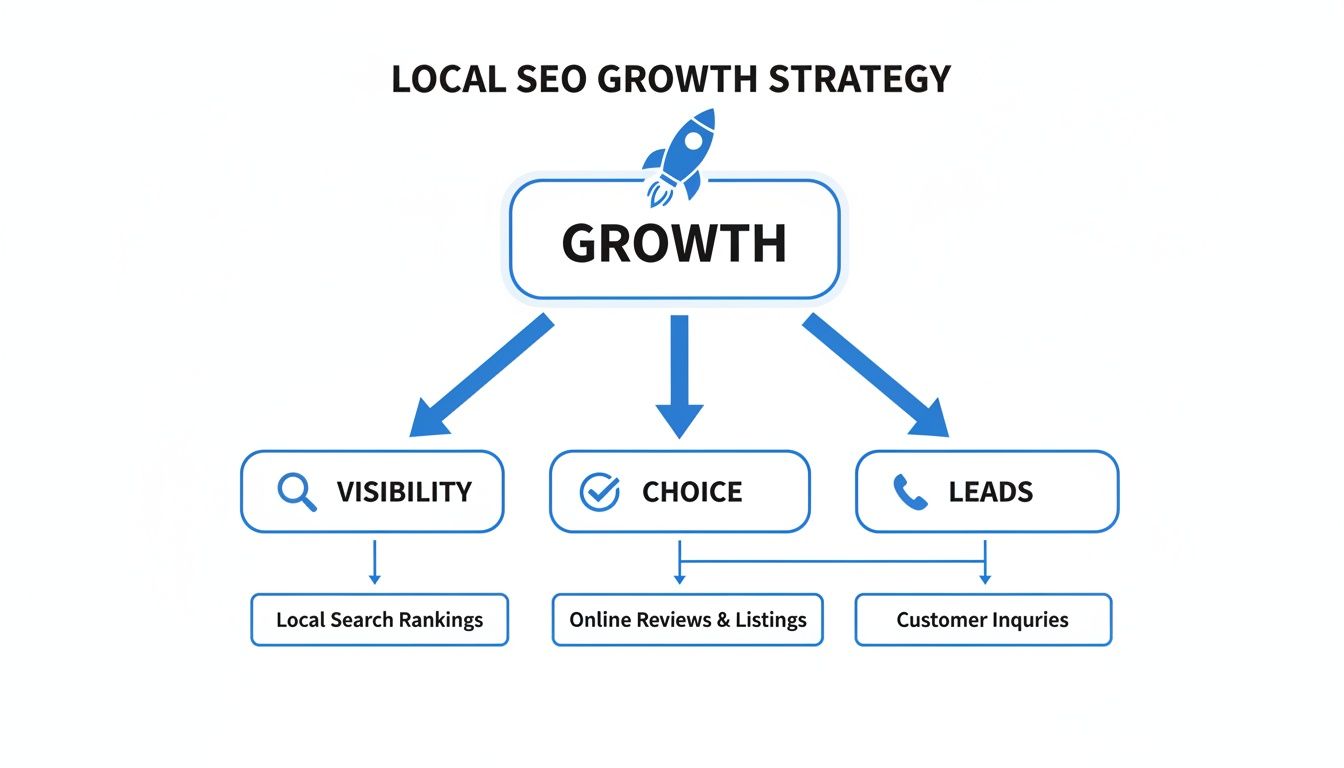
As you can see, real growth comes from a strategy that first makes you visible, then convinces customers you’re the right one to call.
The Three Pillars of Local Ranking
Let's dig into what each of these pillars really means for your business. When you understand how Google thinks, you can make smarter decisions instead of just guessing what might work.
| Pillar | What It Means | Key Optimization Signals |
|---|---|---|
| Proximity | How close is your physical location to the searcher? | Google Business Profile address, service area settings, searcher's physical location. |
| Relevance | How well does your online presence match the search query? | GBP categories, services listed, website content, keyword usage, customer reviews. |
| Prominence | How well-known and respected is your business online? | Review quantity and quality, local backlinks, online citations, brand mentions. |
These aren't just abstract concepts; they are the core components Google's algorithm uses to evaluate and rank your business against competitors every single time someone hits "search."
Proximity: Being in the Right Place
This one’s the most straightforward. Proximity is all about how close your business is to the person searching. If someone in North Austin searches for "luxury kitchen remodelers," Google's first move is to prioritize businesses physically located in or verifiably serving that area. Simple. This is almost entirely dictated by the address in your Google Business Profile and the searcher's real-time location.
Relevance: Matching the Searcher's Need
Next up is Relevance. This is where Google plays matchmaker, trying to figure out how well your business fits what the user is looking for. If the query is "custom home builder," the algorithm scans everything from your business categories and service lists to your website copy and even the language in your customer reviews. Being specific is your best friend here—generic descriptions get lost in the noise.
Prominence: Building Your Digital Reputation
Finally, we have Prominence. This is all about how well-known and trusted your business is in the digital world. Think of it as your online street cred. Google measures this by looking at signals like the number and quality of your online reviews, links pointing to your website from other respected local sites, and mentions of your brand across the web. Improving your local search performance isn't about gaming the system; it's about genuinely proving your value across these three key areas.
A Heads-Up: The Local Landscape Is Shifting
The world of local SEO never stands still, and the integration of AI is changing the game faster than ever. As of January 2026, research shows that nearly 22% of local results now feature AI-powered packs—that's a staggering 200% increase from just a year ago.
Here's the catch: these new AI-driven formats display about 32% fewer businesses than the old-school three-packs. The competition is getting fierce, and only the absolute best-optimized businesses are making the cut. It's no longer enough to just be in the race; you have to be at the front of it.
This shift means knowing exactly where you stand against the competition is non-negotiable. It might be a good time to check out our guide on how to do competitor analysis in SEO to get a clear picture of your market. To win today, you need to master the fundamentals of proximity, relevance, and prominence with more precision than ever before.
Optimizing Your Google Business Profile for Conversions
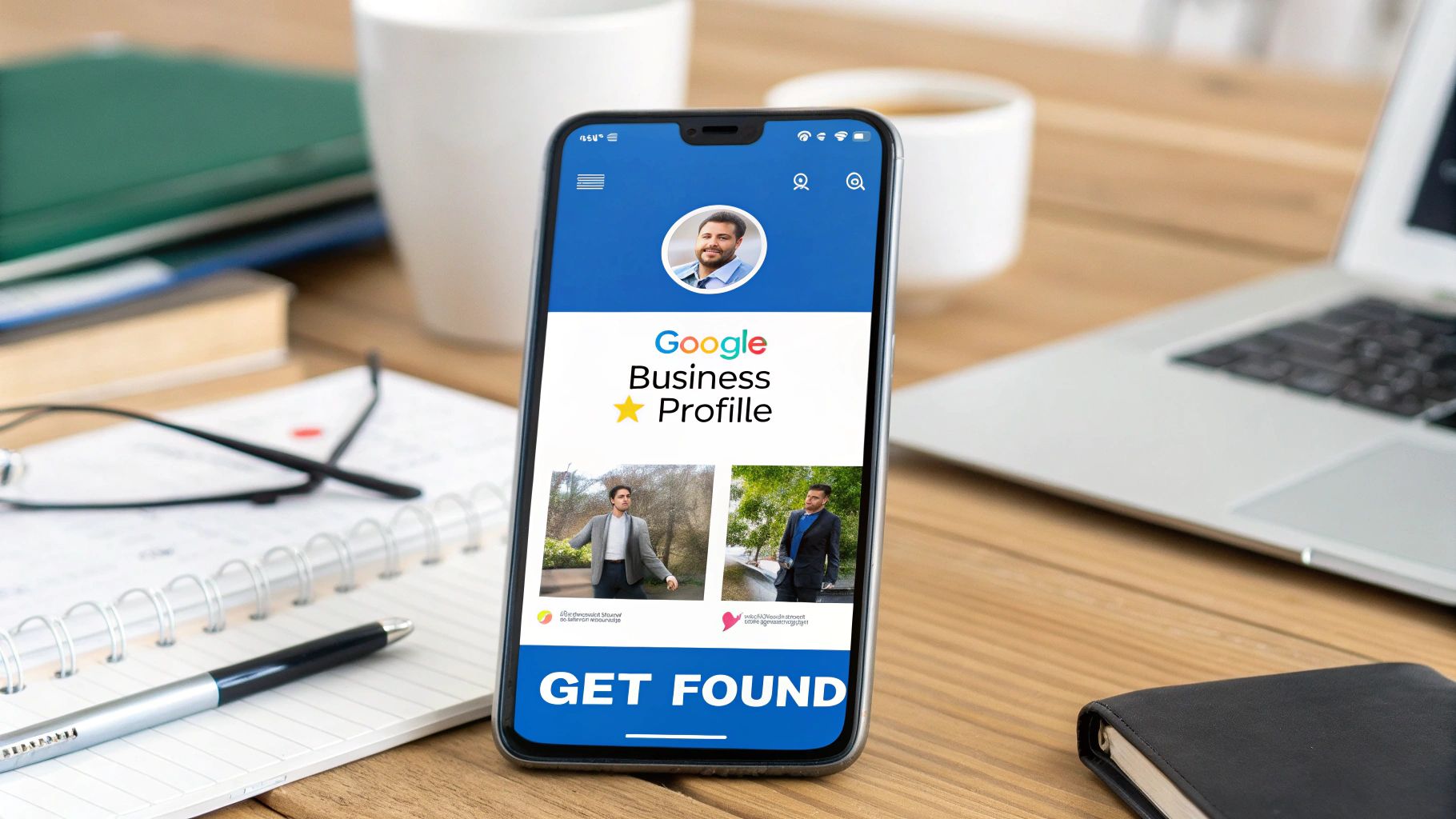
If you do one thing for your local business SEO, make it this: obsess over your Google Business Profile (GBP). It’s easily the most powerful tool you have. Think of it as your digital storefront, your 24/7 receptionist, and your best sales pitch all rolled into one, served up to customers who are actively looking for you.
But just having a profile isn’t enough. The goal is to turn that simple listing into a machine that generates clients. It’s all in the details—the small touches that make you the obvious, premium choice in a sea of competitors. For service businesses and luxury brands, this is where you win or lose that critical first impression.
Nail Your Core Information
The entire foundation of a high-performing GBP rests on one thing: absolute accuracy. Every single detail has to be correct, complete, and a perfect match for your brand. Get this wrong, and everything else you do is built on shaky ground.
Start with your primary business category. Be as specific as you possibly can. If you’re a "Luxury Home Remodeler," don't just settle for the generic "General Contractor." This one choice dramatically influences the signals you send to Google about who you are and what you do.
Next up is your business description. This isn’t the place to just list your services. Tell your story. What makes you different? Talk about your commitment to craftsmanship, the exclusive materials you use, or your white-glove service process. You have 750 characters—use every one of them to build trust and show your value right away.
Bring Your Brand to Life with Visuals
For any brand where aesthetics matter, high-quality photos and videos are non-negotiable. Stock photos are a definite no. Your customers want to see real proof of your work and the quality you deliver.
Invest in professional photography. A luxury retailer needs stunning shots of its storefront and product displays. A high-end contractor should have a gallery of finished projects that highlight the fine details and impeccable finishes. It’s about showing, not just telling.
Try to build a library of different visual assets:
- Finished Projects: Before-and-after photos are gold for contractors.
- Your Team in Action: Show the skilled people behind the service.
- Your Physical Location: Help retail customers picture themselves visiting.
- Product Shots: Crisp, professional images of the items you sell.
Adding new photos regularly does two things: it signals to Google that your business is active, and it keeps your profile fresh for potential clients. For more ideas on visual strategy, check out our guide on local SEO for contractors.
Engage Proactively with Google Posts and Q&A
So many businesses completely ignore two of GBP's best features: Google Posts and the Questions & Answers section. Getting ahead with these tools is a simple way to control the conversation and prove your expertise.
Think of Google Posts as mini-updates that show up directly on your profile. They’re perfect for:
- Announcing new product lines or seasonal collections.
- Showcasing a recently finished project with a link to your portfolio.
- Sharing a limited-time offer or highlighting a core service.
- Posting updates about company news or upcoming events.
The Q&A section is your chance to answer common questions before a customer even thinks to ask. Don't wait for people to post. Fill this section out yourself by asking and answering the questions your sales team hears every single day.
Pro Tip: Seed your own GBP Q&A. Ask common questions about your process, service areas, pricing, and warranties, then write clear, detailed answers. This builds an instant FAQ that saves everyone time and establishes your authority.
This tactic helps you manage your brand's narrative and makes sure potential clients get the right information, straight from the source. When you fully optimize every part of your Google Business Profile, you create an engaging experience that doesn't just get views—it drives real-world business.
Creating Website Content That Dominates Local Search
A great Google Business Profile gets people to your digital front door, but it’s your website that convinces them to step inside. Think of your site's content as the bridge connecting what local searchers need with the solutions you provide. Without that strong connection, even the best-optimized GBP will struggle to convert.
Your website has to deliver on the promises made in your local listings. This is your chance to prove you’re the expert, showcase the quality of your work, and persuade a potential client that you are, without a doubt, the best choice in their specific area.
Uncovering What Your Local Customers Actually Search For
Before you write a single word, you have to get inside your customers' heads and understand the exact phrases they’re typing into Google. This is local keyword research, and it’s the bedrock of a winning content strategy. It’s all about moving past vague, general terms and zeroing in on the high-intent queries that signal someone is ready to make a move.
For instance, a general contractor might think targeting "home remodeling" is enough. But a smart local business SEO strategy digs deeper to find goldmines like:
- "luxury kitchen remodelers in Austin"
- "best bathroom renovation contractor near downtown Dallas"
- "high-end home addition builders Travis County"
These hyper-specific, location-based keywords are where the money is. They reflect a user who has a clear need and a defined geographic area, meaning they're much closer to making a call. You can uncover these gems using free tools like Google's Keyword Planner or even just by paying close attention to the "People also ask" box in search results.
Building Powerful Location and Service Pages
Once you know what people are looking for, it's time to build dedicated pages on your website designed to show up for those exact searches. These pages are your digital billboards, each one perfectly tailored to a specific service in a specific location.
A classic mistake I see all the time is businesses lumping every town they serve onto one generic "Service Areas" page. That’s a huge missed opportunity. A far more powerful approach is to create unique, content-rich pages for each key location. So, a luxury landscaping company in the Austin area should have distinct pages for "West Lake Hills landscaping design" and "Barton Creek landscape architecture."
Each location page should function like a mini-website for that community. It needs to speak directly to the people there, proving you understand their neighborhood and are a part of it—not just some faceless company targeting their city from afar.
These pages can't be flimsy, keyword-stuffed templates. They must offer real value and build instant trust.
Essential Elements of a High-Converting Location Page
To make your location pages truly sing, they need specific on-page SEO elements that scream "local relevance" to both Google and your visitors. Think of them as trust signals that confirm you're a legitimate, reputable local expert.
Here's a simple blueprint for what every strong location page needs to include.
Essential Elements of a High-Converting Location Page
This table breaks down the core components that turn a standard webpage into a powerful local ranking and conversion tool.
| Element | Purpose | Best Practice Example |
|---|---|---|
| Location-Specific Title & H1 | Signals immediate relevance to search engines and users for a specific geographic area. | "Expert Home Automation in Beverly Hills" |
| Embedded Google Map | Visually confirms your service area and provides easy access to directions for users. | An interactive map showing your main office or a defined service area boundary. |
| Local Testimonials | Builds social proof by showcasing positive reviews from clients in that specific city or neighborhood. | "Their team transformed our Bel Air home. We couldn't be happier." – The Smith Family, Bel Air |
| Unique Local Content | Demonstrates genuine local knowledge and prevents pages from looking like duplicate content. | Mention local landmarks, neighborhood-specific building codes, or completed projects in the area. |
| Local Schema Markup | Provides search engines with structured data about your business name, address, and phone number (NAP). | Implementing 'LocalBusiness' schema helps Google verify your information and can lead to rich results. |
By meticulously building out these pages, you're creating highly relevant destinations for valuable local search traffic. It’s a focused strategy that doesn't just help you rank—it dramatically improves your odds of turning that traffic into qualified leads and paying customers.
Building Authority with Citations and Online Reviews
Once your website is tuned up, it's time to build your reputation off-site. This is all about what Google calls "Prominence"—proving that you're not just another business, but a trusted, legitimate player in your local market.
We do this in two primary ways: through citations and online reviews. Think of citations as getting your business listed in all the right local directories, like a modern-day phone book. Reviews, on the other hand, are the digital equivalent of word-of-mouth, and for high-end clients, they're often the final piece of the puzzle.
Achieving NAP Consistency with Citations
A citation is simply any online mention of your business’s key information: its Name, Address, and Phone number (or NAP for short). You'll find these on business directories like Yelp, Angi, and other industry-specific sites.
Google’s crawlers are like digital detectives, constantly cross-referencing this information across the web. When every single mention of your NAP is identical, it sends a powerful signal of legitimacy. But when there are inconsistencies—like using "St." in one directory and "Street" in another—it creates confusion and weakens your local authority.
The mission here is to build a solid portfolio of high-quality citations, all with perfectly matching NAP data. This creates a web of trust that cements your business's identity and physical location in Google's mind.
Cultivating a Five-Star Reputation with Reviews
In the world of luxury goods and premium services, social proof is non-negotiable. Online reviews are the most potent form of social proof there is, directly swaying both customer decisions and your local search rankings. A steady flow of positive reviews demonstrates that you deliver on your promises, giving discerning clients the confidence they need to take the next step.
It’s no surprise that over 90% of people read online reviews before deciding to engage with a business. For luxury brands where trust is everything, that number might as well be 100%. Your reviews are a living testament to the client experience you provide.
Reviews are a direct reflection of your brand's promise. Responding to every single one—positive or negative—shows you're an engaged, customer-focused business that values feedback and is committed to excellence. This level of engagement is a major differentiator.
You need a repeatable process for generating reviews. This isn't a one-off campaign; it should be woven directly into your client workflow.
- Timing is Everything: Make the ask when the client is happiest. For a contractor, that's right after the final project walkthrough. For a luxury retailer, it might be a few days after they’ve received their order.
- Make it Effortless: Send a direct link to your Google review page via email or text. The fewer clicks it takes, the more likely they are to do it.
- Personalize the Ask: A generic email blast is easy to ignore. A personal note from the project manager or sales associate who built the relationship makes the request feel genuine.
How you handle the feedback is just as crucial as getting it. Always thank people for positive reviews. Address negative feedback calmly and constructively. How you handle a public critique can say more about your brand than a dozen five-star reviews ever could.
How to Measure Your Local SEO Performance
A strategy is only as good as your ability to measure it. If you can’t track your progress, you can’t improve. It’s time to move beyond vanity metrics like chasing the #1 keyword ranking and focus on the Key Performance Indicators (KPIs) that actually grow your business.
For any local business, success isn't about topping a random search result; it's about getting real-world actions from qualified local customers. These are the tangible, measurable interactions that lead directly to revenue.
Tracking the Metrics That Matter
Your Google Business Profile is a goldmine of performance data. The "Insights" section gives you a clear dashboard showing exactly how customers are engaging with your listing. Forget about raw impression numbers and zoom in on the actions that show a user is ready to become a client.
These are the core KPIs you should be watching every week:
- Website Clicks: How many people visited your website right from your GBP listing? This is a primary signal of genuine interest.
- Phone Calls: How many potential customers hit the "Click-to-Call" button? This is one of the highest-intent actions anyone can take online.
- Driving Direction Requests: This metric shows you how many people are planning a trip to your physical location—absolutely critical for brick-and-mortar luxury retailers.
These aren't just numbers on a screen; they represent potential sales calls and real foot traffic. Watching these trends over time reveals the true impact of all your optimization work.
Connecting GBP Actions to Website Conversions
The customer's journey doesn't stop on Google. You have to track what happens after they click through to your website. This is where Google Analytics 4 (GA4) comes in, bridging the gap between your local SEO efforts and actual business leads.
On your website, especially your location pages, you need to track specific conversion events. The most important ones include:
- Lead Form Submissions: When someone fills out a "Request a Quote" or "Contact Us" form.
- Phone Number Clicks: Tracking clicks on any phone number listed on your site pages.
- Appointment Bookings: If you use an online scheduling tool, this must be set up as a primary conversion goal.
When you set these up correctly in GA4, you can see exactly how much qualified traffic your local SEO strategy is sending your way and—more importantly—how well that traffic turns into tangible leads.
The whole point of local SEO is to make your phone ring and your inbox fill up with qualified inquiries. Every metric you track should answer one simple question: "Is this helping us get more local customers?"
Advanced Tactics for Scaling Your Efforts
Once you have a solid measurement foundation, you can start exploring more advanced strategies to scale your local authority. One of the most powerful tactics is local link building. This means getting other respected local businesses, organizations, and publications to link back to your website.
Think about sponsoring a local charity event, teaming up with a non-competing luxury brand for a joint promotion, or getting featured in a local design or lifestyle blog. Each of these activities creates a high-quality, relevant backlink that signals to Google that you're a trusted and prominent player in the local community.
These aren't just digital signals; they're the result of building real-world relationships. This approach ensures your local business SEO delivers a significant and lasting return on investment.
Local SEO: Your Questions Answered
Diving into local SEO, especially for high-end service and luxury brands, always brings up a few key questions. Let's get straight to the answers you need to move forward with confidence.
How Long Until I See Results from Local SEO?
Unlike turning on a paid ad, local SEO is more of a long-term play. Think of it like planting a garden—it takes time to grow. While some quick fixes, like getting your Google Business Profile in order, can start showing signs of life in just a few weeks, building real authority in your local market is a different story.
You can generally expect to see real, meaningful movement within three to six months. That's the typical timeframe for Google to notice and index your website changes, see the consistency in your business listings across the web, and start weighing the value of new customer reviews. The key is patience. The results you get are cumulative—they build on each other, creating a powerful, lasting presence.
What's More Important: My Website or My Google Business Profile?
This one comes up a lot. The honest answer? They are both critical and work together as a team. Your Google Business Profile (GBP) is your first impression on the search results page—it's the handshake that gets you noticed in the Map Pack.
But your website is where the real business happens. It’s where you tell your story, showcase your work, and turn a curious searcher into a committed client.
Think of it this way: your GBP earns the click, but your website earns the business. A winning strategy needs both to be perfectly tuned and working in harmony. If one is weak, the other suffers.
Do I Need a Physical Location to Do Local SEO?
For most businesses, especially retail stores or practices where customers visit you, a verifiable physical address is non-negotiable. It's the cornerstone of ranking in the Google Map Pack.
However, if you run a service-area business (SAB)—like a contractor, an interior designer, or a consultant who travels to clients—you've got options. You can register your business at a home address (which you can then hide from the public on your profile) and define your specific service areas. This tells Google the exact cities, towns, and neighborhoods you serve, letting you show up in local searches there, even without a public storefront.
Ready to turn your website into a powerful engine for local growth? At KN Digital, we specialize in designing and optimizing websites for luxury and service brands that convert local searchers into high-value clients. Book a complimentary strategy call today to see how we can elevate your digital presence.